

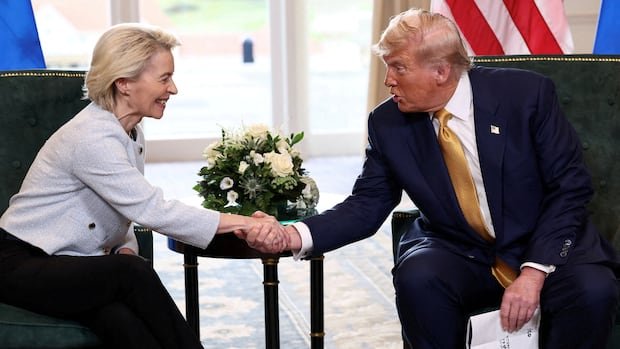

European Union President Ursula von der Leyen made assurances to Europeans during her visit to Donald Trump’s Turnberry golf resort in Scotland last year, promising that agreeing to a blanket 15% U.S. tariff on EU exports would bring “predictability and stability.” However, some critics now view the trade agreement as a one-sided surrender that has led to continued American economic pressure.
Following the implementation of the Turnberry deal, the United States began efforts to reclassify certain European industrial goods for higher tariffs. A new dispute has emerged over Europe’s intention to impose a digital services tax on U.S. tech giants, mirroring Washington’s recent actions towards Ottawa regarding tax terms.
As European resistance grows against Trump’s demands, there is admiration for Mark Carney’s bold stance in exiting the U.S. trade discussions. Former French ambassador Gerard Araud suggested that Canada’s approach of firmness against Trump should set an example for the EU. Lawmakers like German parliamentarian Bernd Lange emphasize the importance of democratic collaboration against such economic coercion.
While Europe has shown reluctance to confront Trump over trade issues, there is appreciation behind closed doors for Canada’s strategy. Observers recognize Canada’s willingness to walk away from unfavorable deals as a potential tactic for pressuring Washington into better agreements.
The United Kingdom’s trade aspirations with Trump have fallen short of expectations, with British exporters facing tariffs and losing competitiveness due to Trump’s trade deals with other nations. The UK’s retreat from a digital services tax under U.S. pressure highlights the challenges in negotiating with the current administration.
Trade experts warn that replicating Canada’s approach may be difficult for Europe and the UK due to differences in public support and economic resilience. While Europe remains quiet amidst the trade tensions, there is a realization that enduring conflicts with the U.S. could have lasting impacts on diplomatic relationships and trade dynamics.
Despite setbacks, there is hope that failed negotiations can be revived in the future. The evolving landscape of international trade relations underscores the need for resilience and the potential for renegotiated agreements in the long run.