

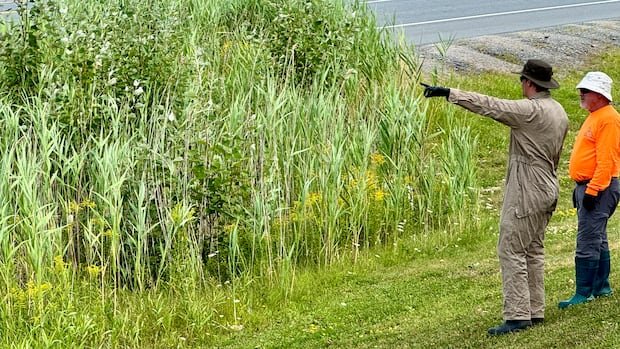

An alien plant species is spreading further into northern Ontario, prompting local communities to take action to identify and manage it before it firmly establishes itself. The Junction Creek Stewardship Committee, based in Sudbury, organized a workshop in collaboration with the non-profit organization Invasive Phragmites Control Centre to educate individuals on how to recognize the invasive phragmites plant and prevent its proliferation.
Invasive phragmites, also known as common reed, can form dense clusters that displace native flora and disrupt the balance of wetland ecosystems. Jayden McGleish, a field supervisor at the Invasive Phragmites Control Centre, highlighted the plant’s encroachment into northern Ontario, with significant patches emerging in Sudbury.
The invasive plant poses a threat to indigenous species like cattails and bulrushes, creating obstacles for wildlife movement. McGleish expressed concern over the challenges faced by turtles and frogs navigating through invasive phragmites, citing instances where these animals have perished due to the plant’s presence. Additionally, the invasive species can encroach on recreational areas by overtaking shorelines and hindering access.
While invasive phragmites is more prevalent in southern Ontario, its prevalence is increasing in northern regions, including Sudbury, Sault Ste. Marie, Timmins, and Thunder Bay. Erik Barr, a contractor at Conservation Sudbury, emphasized the importance of containing the invasive plant in Sudbury before it becomes uncontrollable.
Distinguishing between invasive and native phragmites is crucial. Barr explained that the invasive type typically exhibits wider leaves and thicker stems compared to the native variety, which displays a reddish hue on its stems. Another distinguishing feature is the thickness of the stem-leaf junction line, with the invasive plant showcasing a thin brown line, while the native plant has a more pronounced line.
Educating the public on distinguishing between the two types of phragmites is essential for effective monitoring and management. Jaclyn Groom from the Junction Creek Stewardship Committee emphasized the need to raise awareness, especially as invasive phragmites can spread through transportation by vehicles and equipment along roads and railways. The plant has shown a preference for metal-rich soils near mining sites in Sudbury and has even spread from Copper Cliff Creek to Junction Creek.
In terms of treatment, Chuck Simpson from the Invasive Phragmites Control Centre highlighted the efficacy of using backpack sprayers and a herbicide called Timberline. Demonstrations on treating invasive phragmites were conducted, showcasing a high success rate in controlling the plant’s growth. Despite potential regrowth the following year, the treatment aims to significantly reduce the invasive species’ presence.
In conclusion, proactive measures and public awareness are essential to combat the spread of invasive phragmites in northern Ontario, safeguarding the region’s biodiversity and ecological balance.