

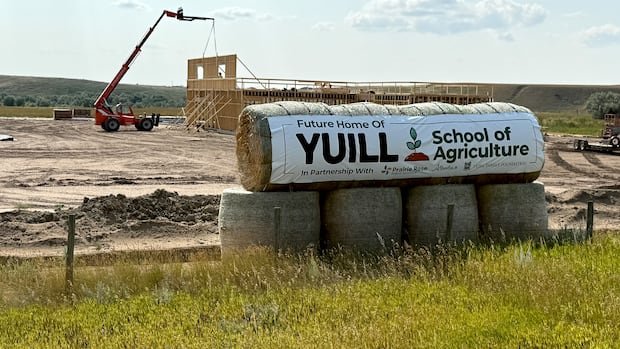

A brand-new barn is currently under construction just outside Medicine Hat, with plans in motion to acquire cattle. The initiative aims to foster the development of future agricultural producers.
Nichole Neubauer, the director of agriculture education at Prairie Rose School Division, described the project as a practical platform for applying agricultural knowledge at a high school level. Students will have the opportunity to engage in hands-on learning and farm management activities.
The Yuill School of Agriculture is envisioned as a dedicated campus for students from a nearby high school, providing instruction and college credits in 12 subjects related to food production, farming, and ranching. The program is expected to accommodate around 100 students in Dunmore, Alta., located approximately 10 km southeast of Medicine Hat.
Construction work commenced this month at the 30-hectare site of the school, situated on land generously donated by local businessman Bill Yuill. The initial phase includes the construction of a main building for labs, classrooms, an equipment shop, and a farmer’s market. Future plans involve the establishment of cattle pens, as well as facilities for honey production, egg farming, and greenhouse vegetables.
The curriculum at the school encompasses a wide range of subjects such as agri-business, technology, food processing, and even organizing U-pick activities and food tourism events. Neubauer emphasized that the curriculum is designed to align with the changing landscape of the food production sector.
Willow Munsch, a Grade 9 student who currently serves as chore manager at the Irvine School Agricultural Discovery Centre, expressed her enthusiasm for enrolling at Yuill when classes commence next year. Munsch, a member of the local 4H club, already raises her own calves on her family’s ranch near Medicine Hat and views the opportunity to study agriculture at Yuill as a dream come true.
Neubauer highlighted that while many students come from farming and ranching backgrounds, it is crucial for producers to adapt to the evolving needs of the sector and the increasing demand for skilled workers.
The Alberta Ag for Life program indicated that there are approximately 79,000 individuals employed in the agricultural sector in the province, with a projected shortfall of 19,000 trained workers by 2030. This summer, 40% of employers reported challenges in recruiting suitable candidates for various roles within the industry.
Bill Yuill, who generously donated land and provided $600,000 to kickstart the project, expressed optimism about the program’s potential during an interview with CBC. The initiative received significant support from local ranching families and agricultural companies, with a fundraising total of $900,000 this summer.
In addition to community contributions, the province has allocated $1.9 million towards the project, alongside donations and division funds, covering the school’s initial budget of $4.5 million.
The Yuill School of Agriculture will be among the 28 “collegiates” in the province, offering specialized classes linked to post-secondary institutions and granting program credits to students. Prairie Rose School Division already operates a collegiate program focused on flight training, enabling students to obtain a pilot’s license.
While many collegiate programs concentrate on trades-related careers, agricultural schools like the Yuill School and others in central Alberta have collaborated with institutions such as Olds College and Lethbridge Polytechnic to nurture careers in agriculture. Neubauer emphasized the importance of educating students about the diverse career opportunities in the industry and the critical role of agriculture in sustaining the planet and feeding the population.