

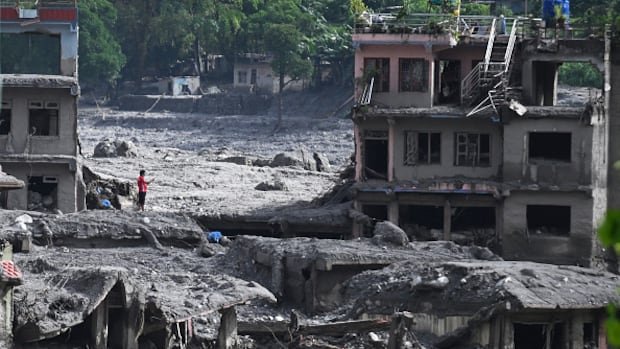

Rescue teams with search canines are actively searching through mud, rocks, and debris along the Nepal-China border to locate the thousands of individuals still unaccounted for after the devastating floods ravaged Himalayan communities, resulting in over 1,000 fatalities.
In Kathmandu, police have interred numerous bodies in mass graves, while Nepal’s disaster agency has confirmed 1,003 deaths and 3,916 missing persons, including 583 foreigners. Meanwhile, China has reported 16 deaths and 546 missing individuals, including 261 foreign nationals.
The extensive damage caused by the disaster on August 26 is impeding rescue operations in both nations, with landslides, obliterated roads, and widespread destruction isolating remote regions. Search teams are facing arduous conditions as they scour unstable terrain and heaps of debris, heightening concerns that the death toll may escalate as rescuers penetrate isolated communities.
Efforts are underway to reach hundreds of workers believed to be trapped inside tunnels at hydroelectric projects in Nepal that were compromised by the floods. Approximately 900 workers are missing from 12 projects, with an estimated 500 trapped in tunnels, as per local authorities.
Nepal’s army spokesperson, Brig. Gen. Raja Ram Basnet, disclosed that teams, supported by international experts, are engaged in rescue operations at various hydroelectric projects. Images released by the army exhibit rescue teams navigating through debris-filled tunnels, wading through mud and water in a bid to locate survivors.
In China, rescue units are combing through areas affected by mudslides, particularly around the Gyirong Port border crossing, which sustained significant damage.
Rescuers, accompanied by search canines, are meticulously exploring crevices amid rocks and debris for any signs of life. Additional teams are utilizing heavy equipment to clear a major highway leading to Gyirong Port, aiming to facilitate the passage of equipment, personnel, and supplies to the disaster zone, as reported by China’s state-run Global Times newspaper.
In Kathmandu, despite heavy rainfall, law enforcement personnel are diligently burying bodies in mass graves adjacent to a wooded area. The site is cordoned off with barbed wire, and the graves are marked with numbered tags for unidentified individuals.
Nepalese authorities are interring bodies in temporary graves until they can be identified, preserving DNA samples, documenting unique facial features, and obtaining other identifying particulars. Each body is assigned a reference number to aid families in later identifying and claiming the remains.
Relief operations have been expanded to reach isolated communities, with over 11,800 individuals rescued thus far by emergency teams employing helicopters and aircraft to access areas where infrastructure was decimated by the flooding and landslides.
Foreign Affairs Minister Anita Anand announced that the federal government is allocating $5 million in emergency aid to Nepal, with additional support earmarked for reconstruction efforts. Anand conveyed Canada’s condolences and solidarity to Nepal’s Foreign Affairs Minister Shishir Khanal, emphasizing concern for the 30 missing Canadians.
Filmmaker and drone pilot Manish Maharjan, who traversed from Tibet into Nepal before the calamity, found himself assisting in rescue operations upon his return. Drones proved useful in locating stranded individuals in challenging terrains, while Maharjan recounted the difficulty of clearing mud-clogged tunnels during rescue missions.
The disaster, triggered by a glacial collapse in the Himalayas, unleashed torrents of rock, ice, and meltwater into valleys below, generating destructive floods downstream. The event, identified as a seismic event of magnitude 5.2, underscored the escalating risks posed by climate change in the region, as emphasized by Nepal’s Prime Minister Balendra Shah.
The catastrophe has emphasized the urgent need for proactive measures to mitigate climate change impacts in the Himalayan region, Shah articulated in a social media post. The disaster has spurred efforts to address climate-related disasters on an international scale.
[End of Rewrite]