


The abrupt shutdown of BioWare, a game studio located in Edmonton, took many players, developers, and industry observers by surprise, though it was somewhat anticipated.
“I had a feeling BioWare’s time was limited, so I had already come to terms with the loss of that studio. When the announcement was made, I thought, yep, that’s pretty much what I expected,” remarked Ash Parrish, a writer at the gaming news outlet Kotaku. “This is really disappointing.”
Founded in Edmonton in 1995 by a trio of doctors and acquired by the U.S. game publisher Electronic Arts in 2007, BioWare was officially closed on Wednesday as part of a company-wide layoff.
The studio was known for its expertise in role-playing games that prioritized narrative depth and player choice, with notable titles such as Baldur’s Gate, Star Wars: Knights of the Old Republic, Dragon Age, and Mass Effect.
“Our thoughts are with all those impacted by this news, as well as their families and colleagues. Canada’s gaming sector boasts extraordinary talent and creativity, and the legacy of those who built BioWare will forever be a significant chapter in our industry’s history,” stated Paul Fogolin, president of the Entertainment Software Association of Canada.
Online, gamers, developers, and critics expressed their sorrow over the news, with many acknowledging how BioWare’s creations had inspired their own careers in the gaming world. They highlighted that although BioWare is no longer operational, its influence on the gaming industry will persist.
Financial Strains Following Saudi Acquisition
The recent financial state of EA made BioWare’s closure less surprising. The number of employees at BioWare was reduced from around 200 to less than 100 in 2025 after Dragon Age: The Veilguard did not meet internal sales targets.
Earlier this year, Saudi Arabia’s sovereign wealth fund, along with a private equity firm led by U.S. President Donald Trump’s son-in-law Jared Kushner, completed a $55 billion US acquisition of EA. This deal involved $20 billion borrowed from JPMorgan, which now looms over EA as leveraged debt.
Alyssa Mercante, a digital trends journalist for Digiday and a former games writer, suggested that EA likely prioritized maintaining its “biggest revenue generators,” such as sports games and online shooters with live service features, over titles with “long development timelines” and the intricate RPGs for which BioWare was known.

BioWare, located in Edmonton, is permanently closing its doors. Its parent company Electronic Arts stated that the focus will shift towards the development of larger shooters and action-adventure games. This decision led to EA’s closure of BioWare and the halt of early development for the next Mass Effect title, one of its flagship franchises. BioWare has had a presence for over 30 years, creating numerous games that have become classics in the gaming landscape. Trent Oster, one of the original co-founders, now leads the gaming company Beamdog.
Live service games provide ongoing content, which sometimes includes randomized packs that incur additional costs or subscriptions beyond the initial purchase. EA attributed a revenue of $1.47 billion US from live service games like Battlefield 6 and the soccer series EA Sports FC for the previous quarter.
In contrast, RPGs like Dragon Age and Mass Effect are typically sold as standalone experiences, with limited opportunities for monetized content after the initial sale.
Innovative Narratives, Diverse Characters and Stories
BioWare’s titles have long been praised for featuring characters with diverse gender identities and backgrounds. For instance, players can select the gender of the protagonist, Shepard in Mass Effect or Hawke in Dragon Age. Some titles also incorporate optional same-sex romantic arcs and narratives including transgender characters.
Gaming writer Parrish attributes her recovery from a challenging period in her life to Dragon Age: Origins (2009).
“I thought, let me give it a shot and see if it brings me joy. And it did,” she recalled. “It fundamentally changed my brain chemistry in ways that I still feel today.”

A promotional screenshot from Dragon Age: The Veilguard. (BioWare/Electronic Arts)
She credits it with motivating her to pursue a career in game journalism and connecting her with online communities of Dragon Age enthusiasts who later became lifelong friends, even attending her wedding.
Mercante experienced a similar connection when she first engaged with Mass Effect, the sci-fi counterpart of Dragon Age.
“It intertwined itself with my core personality and remained there throughout my teenage years and early twenties,” she shared.
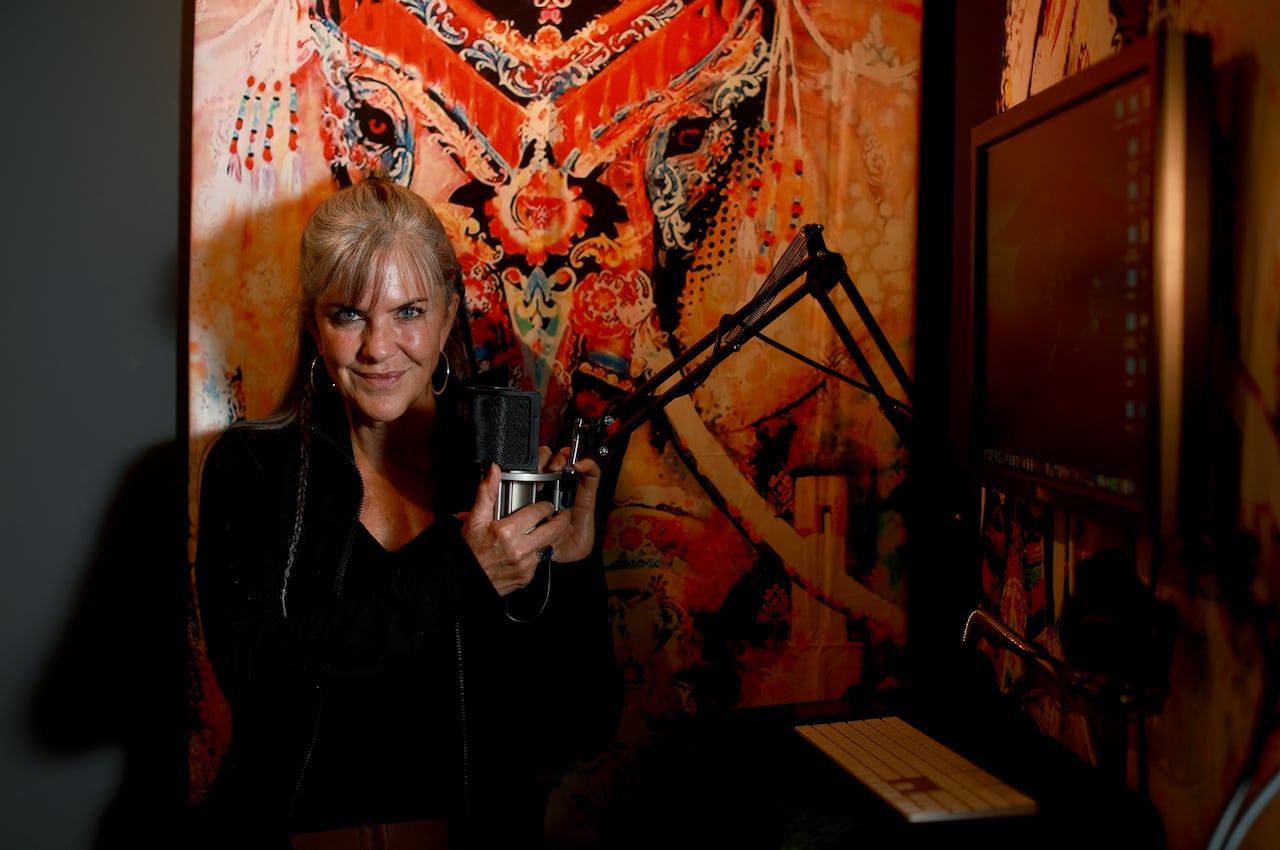
Voice actress Jennifer Hale is captured in her studio on Vancouver Island, B.C., in 2024. (Chad Hipolito/The Canadian Press)
At the beginning, players could choose to play as a male Shepard, voiced by Mark Meer, or “FemShep,” as fans refer to her, voiced by Jennifer Hale from Vancouver Island.
“Being FemShep holds immense significance for me,” Hale expressed, describing it as “an extraordinary privilege” to portray a lead character whose female version was regarded on par with her male counterpart.
“This means a lot to me. I love breaking down barriers.”
Natalie Checo, a video game designer based in Vancouver but originally from the U.S., mentions her connection with Miranda Lawson, a genetically enhanced character in Mass Effect 2.
“What resonated with me was the narrative of a woman engineered to be perfect, yet she struggles to achieve that, highlighting the unattainable nature of perfection,” she remarked. “Women often face societal pressure to strive for perfection.”
Checo notes that many of her friends in game development belong to marginalized groups, and BioWare’s titles “encouraged us to aspire beyond what our reality has permitted us to feel we could achieve.”
Enduring Legacy
Osama Dorias, a developer in Montreal at HeartLoop Games, states that BioWare’s games imparted valuable lessons for his own work on narrative-driven titles.
“Upon playing Mass Effect 1, I was astonished by the level of agency afforded to the protagonist Shepard and how the characters retained their distinct personalities,” he noted.

Varric the dwarf and Solas the elf are featured in Dragon Age: Inquisition. (BioWare/Electronic Arts)
Dorias, along with Mercante and others, highlighted the success of RPGs from other developers that have continued to build on that model, such as CD Projekt Red’s The Witcher series and Baldur’s Gate 3, a sequel to BioWare’s original games created by Belgian studio Larian.
Dorias described BioWare’s closure as “heartbreaking,” estimating that at its height, the studio may have represented half of the full-time workforce in Edmonton’s gaming sector.
He pointed out that several indie studios have emerged over the years from former BioWare employees, developing games that may diverge significantly from its RPG framework but still embody “the same strong character development and storytelling.”
“I cannot emphasize enough the significant influence that BioWare’s franchises had on the broader industry. Their impact was truly substantial.”
Hale Hopes BioWare’s IPs Will Endure
Following BioWare’s closure, a trailer for the now-canceled Mass Effect game surfaced online, allegedly leaked by a former employee of the studio.

An image from a purportedly leaked trailer for an upcoming Mass Effect game from BioWare. The studio was closed by its parent company Electronic Arts on Oct. 21, and the game was canceled mid-development. (Dejahvoe Ivoe/YouTube)
After viewing the trailer, Hale described it as “stunning” and expressed her hope that if EA has no intentions of allowing one of its other studios to complete the game, it might sell the IP to another team to finish the project.
“I believe fans would be thrilled if that IP found a home with a small, independent studio…. They would generate a significant amount of goodwill,” she said.
“So, let that IP go and allow us, the community, to engage and create beautiful stories that are still waiting to be told.”