

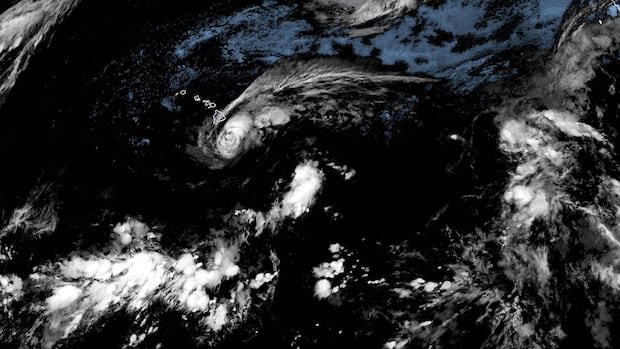

Tropical storm Lala has started to impact Hawaii’s Big Island early Saturday, with predictions suggesting it could intensify into a hurricane or at least bring strong hurricane-force winds as it nears the coast. The National Hurricane Center (NHC) has issued a rare hurricane warning for the island, which has not experienced a direct hurricane landfall in over 155 years.
Meteorologists have warned that areas at higher elevations could receive up to 635 millimeters of rainfall, increasing the risk of life-threatening mudslides in mountainous regions where residents live in makeshift accommodations off the grid. Governor Josh Green described the storm as significant, with tropical storm force winds extending up to 350 kilometers and expected to impact Oahu and Kauai by Sunday morning. Potential consequences include destructive flooding and wildfires sparked by strong winds in the affected areas.
A hurricane warning has been issued for the Big Island, while a tropical storm warning covers Maui County, encompassing Maui, Molokai, Lanai, and Kahoolawe islands. Additionally, tropical storm warnings are in place for Oahu and Kauai County, including Kauai and Niihau islands.
Even if Lala falls short of becoming a hurricane upon landfall, the NHC cautioned that wind speeds in elevated locations and on both windward and leeward slopes could be significantly stronger than near-surface winds, potentially reaching nearly hurricane-force levels in high-altitude communities in Hawaii.
Historical data indicates that a Category 3 hurricane struck the northeast corner of the island in 1871, with current forecasts suggesting Lala will make landfall very close to the southern tip of the Big Island. Officials and residents are preparing for the storm’s impact, with shelters set to open and various events canceled as a precaution.
The NHC forecasted rainfall totals of 203 to 305 millimeters across Maui and lower elevations of the Big Island, and 102 to 152 millimeters across the entire island chain, warning of potential life-threatening flooding, mudslides, storm surges, and dangerous ocean swells leading to hazardous surf and rip current conditions.
As of 5 a.m. local time in Hawaii, tropical storm Lala was situated approximately 175 kilometers southeast of South Point, Hawaii, with maximum sustained winds of 100 km/h, moving west-northwest at 20 km/h, according to the hurricane center.
State Representative Jeanné Kapela emphasized the importance of taking the storm seriously and encouraged residents to stay vigilant, particularly in the rural and remote southern region of the Big Island where concerns about the ability of unpermitted structures to withstand hurricane force winds are high. Many parts of Hawaii are still recovering from devastating floods, making preparedness crucial.
Growers, still recuperating from the spring floods, expressed concerns about potential damage from the approaching storm. Wildfire risks were highlighted as winds picked up, with dry and breezy conditions exacerbating the situation. Kauai’s history of experiencing a Category 4 hurricane in 1992 during an El Nino year underscores the need for vigilance during such weather events.