

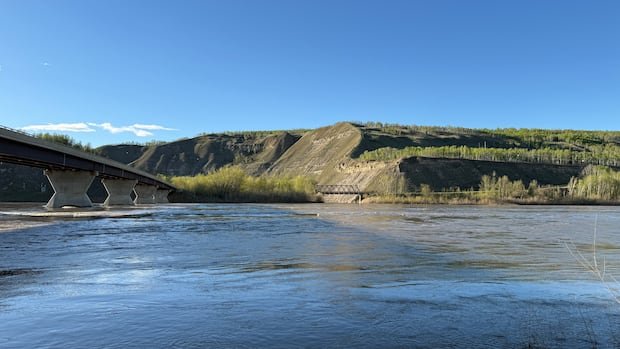

Leaders in the northeastern region of British Columbia are advocating for a new fund to compensate local communities in the event that the province proceeds with constructing a fourth hydroelectric dam on the Peace River. During a public briefing by B.C. Hydro on Thursday, the Peace River Regional District was informed about Site E, situated near the Alberta border north of Dawson Creek.
Should the dam project be greenlit, board chair Brad Sperling emphasized that significant alterations to the river system in B.C. would occur. This would result in the submerging of additional residents, farmlands, public parks, infrastructure like bridges, and impacts on local water sources. Sperling expressed concerns, stating that the Peace River would essentially transform into a series of reservoirs extending to Finlay Bay.
B.C. Hydro has justified the need for new sources of reliable power to meet an anticipated 50% surge in power demand by 2050, mainly driven by industrial expansion. However, Sperling argued that the cumulative effects of previous energy developments, including three existing dams on the Peace River and the continued establishment of significant wind farms, have already left lasting consequences.
He suggested that the region should have a compensation mechanism akin to the Columbia Basin Trust, established in 1995 to support communities affected by dams on the Columbia River. Presently, the trust boasts assets exceeding $1.2 billion.
According to Sperling, the northeast region has been shouldering the burden of energy generation without reaping adequate economic benefits. Legislative adjustments are required as Site E is presently prohibited under the Clean Energy Act, alongside another hydro proposal on the Homathko River in the Coast Mountains. B.C. Hydro representatives anticipate governmental modifications to permit geotechnical and environmental studies at both sites.
Julia Balabanowicz, B.C. Hydro’s government relations director, explained that these projects are crucial options to address future energy requirements, along with utility-scale battery initiatives. Preliminary studies for both proposals are estimated to cost up to $12 million.
Local officials echoed the call for long-term compensation, with concerns raised about the strain on land and resources due to new energy ventures. Residents and leaders expressed fatigue and discontent, underscoring the necessity for alternative energy solutions such as nuclear and natural gas to meet the region’s energy demands.