

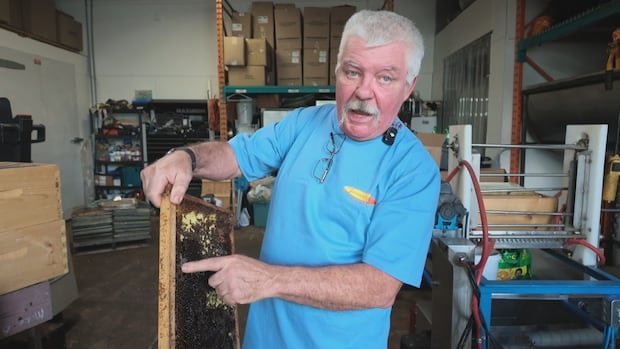

New tariffs imposed by the United States on honey could have a detrimental impact on honey producers in Windsor-Essex and Chatham-Kent, even if they do not directly sell to the U.S. Mike Davidson, the owner of Summer’s Gold Honey Company in Chatham-Kent, expressed concerns that major Canadian honey producers in the Prairies might redirect their sales to Ontario, leading to a drop in honey prices and making it challenging for small producers to sustain their businesses.
Davidson highlighted that western beekeepers from Alberta, Manitoba, and Saskatchewan operate as a co-op. In case they face pressure to offload their honey, they may flood the Ontario market with inexpensive products, prompting local beekeepers to lower their prices to remain competitive, despite having smaller crop yields.
Apart from producing honey, Davidson’s company also distributes honey from other producers. He mentioned that if prices decrease, he would opt for the cheaper western honey for distribution to stay competitive. However, he acknowledged that this could disadvantage local producers and give larger producers a chance to dominate the market.
Honey is among the numerous items facing a 50% U.S. import tariff if a trade agreement between Canada and the U.S. is not reached by August 19. In 2025, Canada exported nearly $28.5 million worth of honey to the U.S., representing approximately 12% of the total Canadian honey production value of around $241 million.
Hawksview Honey, a Harrow-based honey producer, emphasized the potential impact of western honey exporters looking to expand their market presence in Ontario. Dale Wright, the owner of Hawksview Honey, expressed concerns that if these exporters reduce their prices due to the tariffs, consumers may prefer their products over local honey, affecting smaller producers’ livelihoods.
Rod Scarlett, the executive director of the Canadian Honey Council, mentioned that significant changes in the industry may not occur until 2027, as most of this year’s honey exports to the U.S. have already been delivered. Scarlett urged the Canadian government to consider implementing retaliatory tariffs on U.S. honey and increasing honey import testing to address the issue of honey adulteration with syrups.
Lorne Prins, the vice-chair of the Canadian Honey Council and an Alberta beekeeper, highlighted the nuances of the Canadian honey market, noting that honey preferences vary across regions. For instance, Prairie honey is lighter in color, while consumers in Ontario prefer darker honey products.