

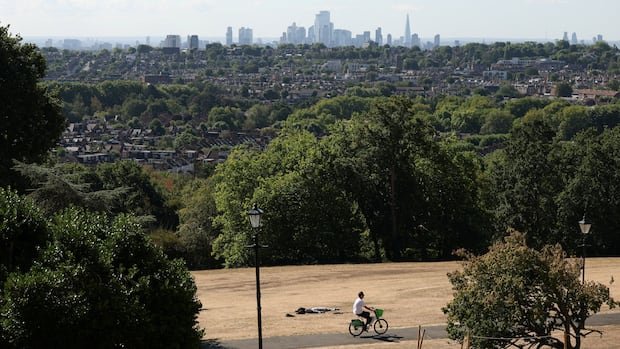

Amid a heatwave and severe drought in Britain, Divya Hariramani was tending to a plum tree in south London when she noticed a branch starting to split from the tree. The workers at Mitcham Community Orchard explained that the stress caused by the heat was leading to this issue.
London, known for its stone architecture, is also famous for its extensive urban forest, considered the largest worldwide. However, this year has brought challenges for the lush canopy due to multiple heatwaves and a lack of rain, impacting plants and wildlife. A recent report from Royal Botanic Gardens Kew warns that by the end of the century, 73% of the city’s trees could be at risk of dying due to climate change.
The Kew Gardens team, in collaboration with the Greater London Authority, assessed over a million public trees and found that many are already unsuitable for future climate conditions without emission reduction efforts. In 2022, 400 trees at Kew Gardens died due to extreme heat and drought. The Gardens left a red oak tree standing as a stark reminder of the impact of climate change on London’s trees.
The city experienced its driest July on record, leading to challenges for farmers, food shortages, and wildfires. The prolonged heat and drought affected park grass, tree foliage, and overall landscape appearance, prompting concerns about the future of London’s trees.
As temperatures in London are expected to rise, botanists are considering planting tree species better suited to warmer and drier conditions. The Carbon Garden at Kew Gardens showcases different plant species’ responses to changing climates, aiming to raise awareness about climate change resilience.
Paul Wood, an author passionate about London’s trees, expressed concerns about the impact of extreme weather on the city’s green spaces. Ancient woodlands like Highgate Woods and Hampstead Heath, home to trees with centuries of history, are facing challenges due to climate stress. Wood highlighted the significance of these trees not only for their history but also for the biodiversity they sustain, emphasizing their irreplaceable value.