

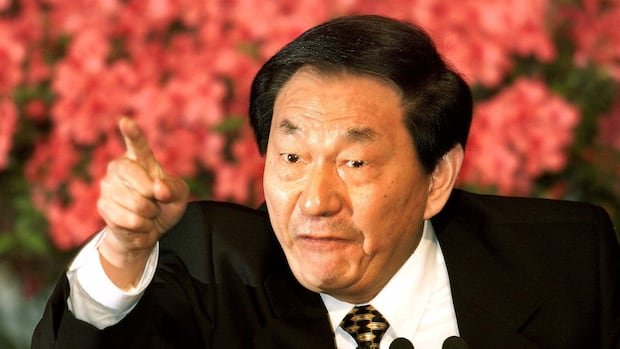

Former Chinese premier Zhu Rongji has passed away at the age of 97, as reported by state media. The official Xinhua news agency announced that Zhu succumbed to an illness in Beijing at approximately 11 a.m. on Wednesday. Known for his impatience and sharp-tongued demeanor, Zhu played a pivotal role in propelling China’s economic growth by implementing significant reforms in the 1990s, including steering the country into the World Trade Organization.
Despite facing exile in rural areas due to his support for reforms in other communist nations, Zhu spearheaded a series of transformative changes during his tenure as premier, a key economic position in China, from 1998 to 2003. His initiatives, which aimed at enhancing efficiency and profitability of state-owned enterprises, led to millions of job cuts but ultimately contributed to China surpassing Japan as the world’s second-largest economy after the United States in 2010.
Credited with building upon Deng Xiaoping’s reforms in 1979, Zhu was instrumental in groundbreaking developments such as China’s WTO membership, a move that played a crucial role in propelling China to become the globe’s leading exporter. These reforms sustained robust economic growth, maintaining an annual rate above eight percent from 2000 to 2010, reaching a peak of 14.2 percent in 2007.
Assuming the position of premier at the age of 69 in 1998, Zhu garnered popularity by openly criticizing bureaucratic inefficiencies and corruption while taking responsibility for governmental shortcomings. His assertive leadership style earned him nicknames like Boss and Zhu Fengzi, reflecting his uncompromising approach towards governance.
Zhu, ranking third in the party hierarchy behind President Jiang Zemin and Li Peng, the head of the National People’s Congress, earned recognition for curbing inflation as a deputy premier in the 1990s. He actively pursued WTO membership, navigating complex negotiations that commenced in the 1980s. Despite facing challenges, Zhu successfully steered China towards WTO acceptance in December 2001, marking a significant milestone in the nation’s economic trajectory.
Notably, Zhu kickstarted a surge in home ownership in 1998 by initiating the sale of apartments owned by state enterprises, leading to a widespread shift towards private ownership within urban housing markets. While advocating for market-oriented reforms, Zhu remained committed to retaining government ownership in key sectors such as banks and oil companies, emphasizing a balanced approach to economic development.
Born in Mao Zedong’s home province of Hunan on October 23, 1928, Zhu’s career endured a tumultuous phase marked by political persecution during the Cultural Revolution. However, he made a remarkable comeback in 1979, swiftly ascending the political ladder to key positions such as deputy Shanghai party secretary and mayor. Demonstrating a conciliatory approach during his tenure as mayor, Zhu diffused tensions and avoided military intervention amid political unrest in 1989.
Zhu’s legacy is also characterized by his willingness to acknowledge official failures, a rare trait in Chinese leadership. From criticizing lax flood defenses to publicly apologizing for government lapses resulting in tragic incidents, Zhu’s candid approach endeared him to the public. His adeptness at humor and self-deprecation further endeared him to the populace, injecting a sense of relatability into his leadership style.
A notable achievement in Zhu’s career was the implementation of a tax system that redirected more revenue to the central government, a move he humorously suggested should earn him a Nobel Prize in economics. Zhu’s legacy as a transformative leader is etched in his unwavering commitment to economic reforms and his candid approach to governance, leaving an indelible mark on China’s modern history.