

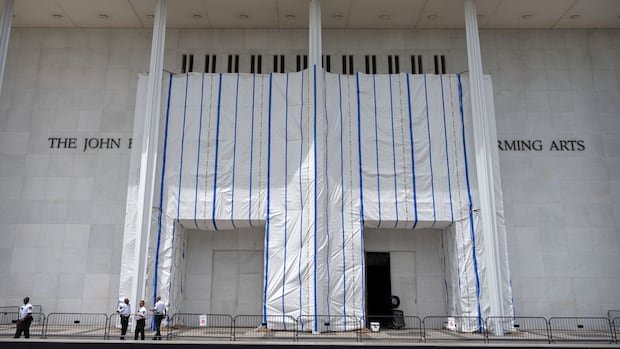

The debate regarding the future of the Kennedy Center intensified on Thursday as supporters of U.S. President Donald Trump on the board initiated actions to honor him through physical alterations to the renowned arts venue, potentially defying a court ruling. In a lengthy virtual meeting, the board decided to incorporate Trump’s name into the building’s facade, transforming it into “The John F. Kennedy Center for the Performing Arts Restored and Renovated By President Donald J. Trump.” Additionally, they proposed naming the plaza in front of the center after Trump and outlined plans to shut down most of the venue for two years to facilitate extensive renovations.
Representative Joyce Beatty, an Ohio Democrat and ex-officio board member, along with her legal team, characterized these modifications as a significant challenge to U.S. District Judge Christopher Cooper. Judge Cooper had previously ruled in May that affixing Trump’s name to the building was unlawful, ordering its removal, a decision that the Trump administration failed to overturn. Concurrently, Cooper blocked a planned two-year closure of the center, criticizing the board’s initial decision as uninformed and predetermined.
Beatty condemned the recent developments as an attempt to circumvent the court’s decision and violate established statutes, vowing to continue advocating for the preservation of the national monument. The Kennedy Center representatives were unavailable for immediate comment on the matter.
The board meeting primarily focused on determining the extent of closures necessary for the essential renovations aimed at enhancing safety within the center. In response to the criticism from Judge Cooper, the institution’s leadership presented the board with three alternatives, including a total closure, a partial closure with limited public access, and a phased closure targeting critical infrastructure needs while maintaining regular programming.
Ultimately, the board opted to close the center for two years while considering the possibility of hosting some events in an outdoor area called the Reach. This decision, coupled with the efforts to honor Trump, has raised concerns about the thorough consideration of alternative options by the board.
Trump’s recent actions at the Kennedy Center are emblematic of his broader initiative to reshape the physical landscape of Washington, D.C., during his second term. His interventions included replacing the institution’s leadership with handpicked allies and adding his name to the building, a move later retracted following legal orders. Trump’s endeavors extend to other iconic locations in the capital, such as the White House and Lincoln Memorial Reflecting Pool, where he has proposed substantial changes despite facing legal challenges and pushback.
Leadership at the Kennedy Center has stressed the urgent need for repairs and updates within the facility. Executive Director Matt Floca highlighted severe water damage and aging equipment during a tour of the building, underscoring the necessity for comprehensive renovations rather than piecemeal fixes. The ongoing legal disputes surrounding the center have attracted attention, even becoming a subject of humor at public events.
As the saga unfolds, the future of the Kennedy Center remains uncertain, with conflicting interests and legal battles shaping the institution’s trajectory. The decision to honor Trump through structural modifications and the planned closures for renovations have sparked a contentious debate over the center’s governance and preservation.