

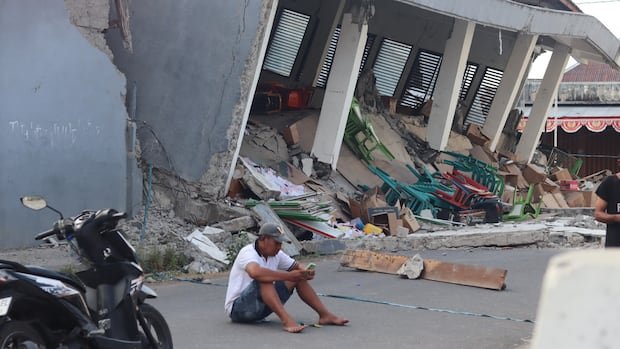

Approximately 5,000 individuals were forced to evacuate following a powerful magnitude-7.7 earthquake that struck eastern Indonesia, resulting in a death toll of at least 53 and causing significant infrastructure damage, including blocked roads and landslides. Authorities reported that over 130 people sustained injuries, many of whom suffered broken bones.
This seismic event on Saturday marked the deadliest earthquake in Indonesia since 2022 when a quake in West Java claimed the lives of hundreds. The disaster mitigation agency BNPB disclosed that more than 3,300 people in the Sikka region either self-evacuated or sought refuge in a sports arena.
Residents of Sikka found themselves stranded outside collapsed homes, seeking shelter under makeshift tarps. In a temporary hospital set up in Maumere, some individuals received medical attention in tent facilities. Abdul Mutas, 63, shared his experience of fleeing with his family to higher ground as the quake struck, leaving them with only the clothes on their backs.
Simon Subandi, deputy regent of Sikka, mentioned that the majority of residents opted to sleep outdoors due to fear of aftershocks. The government swiftly mobilized over 3,500 military and police personnel to assist in the affected region, aiming to provide aid and maintain order.
Concerns about aftershocks loomed large among residents, with nearly 1,000 recorded tremors following the initial quake. Nearby, a sports stadium became a bustling evacuation site where residents queued for essential supplies, mothers improvised cradles from clothing scraps, and children played outdoors to alleviate anxiety.
The earthquake reignited painful memories for Margaretha Movaldes Da Maga Bapa, head of the region’s disaster mitigation agency, who recalled the trauma of the 1992 quake. Search and rescue efforts focused on clearing debris in severely impacted areas to locate possible survivors, although challenges such as landslides and ongoing tremors slowed progress.
While power restoration efforts were nearly complete, authorities continued working to repair damaged distribution lines. The East Nusa Tenggara government declared a state of emergency for the province, enabling the coordination of resources and funding to support recovery initiatives.
Geology expert Dwikorita Karnawati highlighted the seismic vulnerabilities of the region, attributing the earthquake risk to the presence of the “Flores back-arc thrust fault.” Indonesia’s history of seismic activity along the “Pacific Ring of Fire,” a volatile tectonic zone, underscores the nation’s susceptibility to earthquakes and volcanic eruptions.