

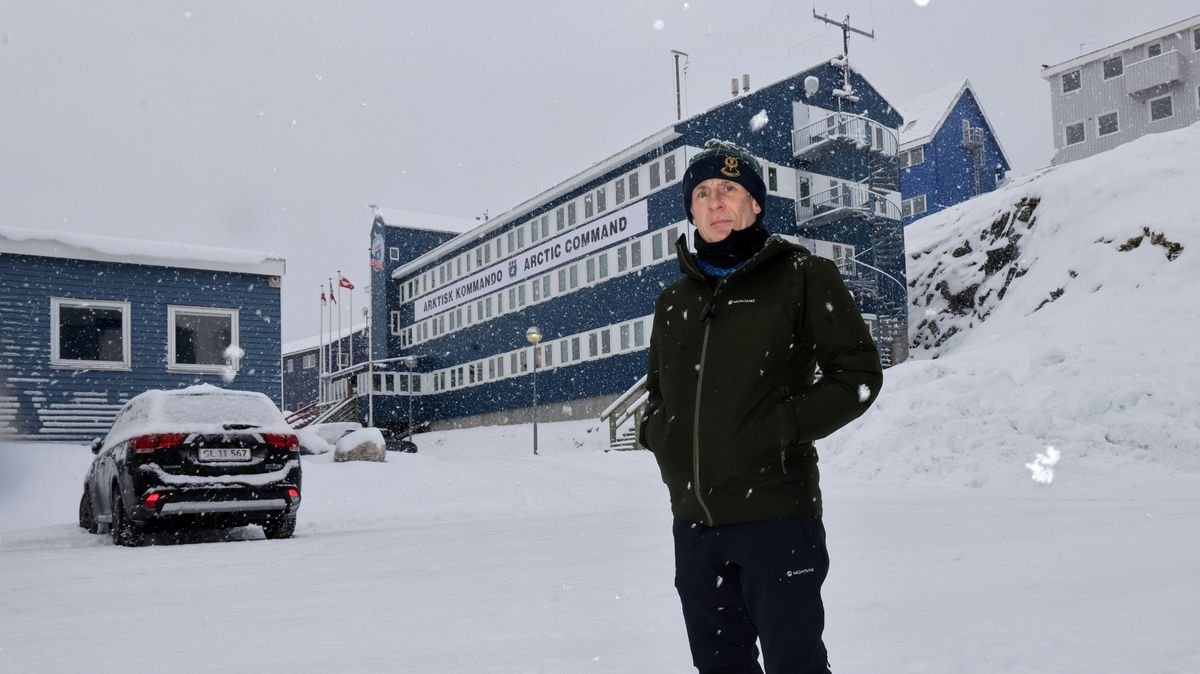

Danish military personnel stationed at the Joint Arctic Command in Nuuk, the capital of Greenland, are facing a heightened level of seriousness in their operations. The modestly designed blue building where they are stationed lacks significant fortifications that would deter potential aggressors, including the United States.
Following Donald Trump’s announcement of plans to acquire Greenland in January 2025, there was a £3.5 billion expansion initiative in the Arctic. This expansion includes the establishment of a new command headquarters in Nuuk to actively monitor potential threats in the Arctic region.
In a peculiar turn of events considering Trump’s war rhetoric, Denmark is procuring an additional 16 F-35 fighter jets from the US, increasing its total fleet to 43 aircraft. Despite this bolstering of defenses, Trump trivialized the investment, commenting that it would only add a “single dog sled.”
Months before Trump’s controversial suggestion of using force to acquire Greenland, Denmark’s Defense Minister Troels Lund Poulsen emphasized that the agreement significantly enhances the Danish Armed Forces’ capabilities in the region.
The Arctic region plays a crucial role as a strategic gateway connecting North America, Russia, and Europe. Denmark collaborated with the governments of Greenland and the Faroe Islands to develop a comprehensive defense package, which includes the acquisition of two new Arctic ships, maritime patrol planes, drones, and early warning radar systems.
Personnel stationed in Nuuk are aware of their legal obligation to engage any invaders, irrespective of the odds. A directive dating back to 1952 mandates soldiers to open fire without awaiting orders in the event of an invasion of Danish territory.
Danish Prime Minister Mette Frederiksen warned that any military attempt to seize Greenland, an autonomous territory within the Kingdom of Denmark, would jeopardize NATO’s integrity. Trump’s claims of Russian and Chinese ships swarming Greenland were refuted by Danish and Norwegian defense authorities, who have noted heightened Russian naval activities in the Arctic but have not detected Chinese warships in their vicinity.