

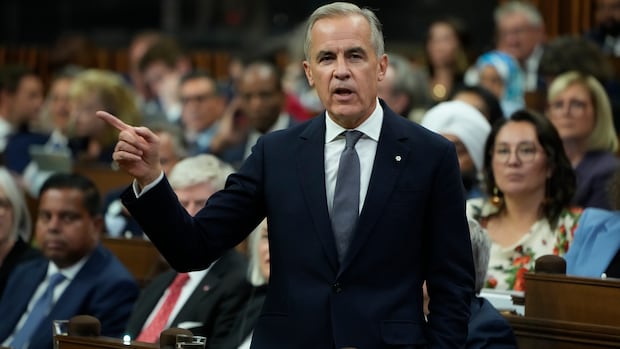

As Parliament prepares to resume, Mark Carney aimed to temper expectations.
“We are gathering at a pivotal time for our nation,” the prime minister stated to a gathering of Liberal MPs on Friday.
Towards the conclusion of his address, Carney informed his caucus that this would signify “a vital session of the House of Commons.”
“We will be presenting some of the most significant legislation, not only of this administration but in decades,” he declared.
While consequences are typically assessed retrospectively, the prime minister’s bold and ambitious predictions appeared to resonate with the current climate.
-
FRONT BURNER
Politics! Parliament’s ‘consequential’ agenda
-
MPs are heading back to Parliament Hill. Here’s what to watch this sitting
-
Carney rallies Liberal MPs as ‘crucial session’ of Parliament set to resume
The broader context in which Canada currently exists has been evident for approximately 20 months — since the U.S. president began referring to Canada as the 51st state, or when he damaged the Canadian-American relationship through a series of unjust tariffs. However, in a matter of weeks this summer — from the breakdown of trade negotiations with the United States in late August to last week’s investment summit and Carney’s speech to the European Parliament — the situation has appeared to take on increased urgency and momentum.
With favorable political conditions surrounding him, Carney is now promoting a legislative agenda that aligns with the current moment.
The Building Canada Strong Act, introduced on Monday, may become the central element of that agenda, though it is likely just the beginning. New regulations for social media, proposed last spring, are pending discussion. The management of Canada’s largest airports could potentially be handed over to private investors. Additionally, the Carney administration’s second budget — and its first with a majority in the House — is expected to be presented later this fall.
Outside Parliament Hill, significant events are on the horizon: a Quebec election scheduled for Oct. 5, a referendum in Alberta on Oct. 19, and a Canada-European Union summit in Montreal on Oct. 29. The Supreme Court is anticipated to issue a ruling regarding the notwithstanding clause, a provincial election in British Columbia could be imminent, and as many as six federal byelections may be called.
However, on the opening day of the fall session, the Official Opposition aimed to draw attention to the most pressing issues.
The Conservatives aim to reduce costs for Canadians
“To the Canadian populace,” Conservative Leader Pierre Poilievre stated, addressing the television camera directly, “the Conservatives’ message is that we will fight to lower your expenses.”
A month earlier, Poilievre had urged the prime minister to reconvene Parliament immediately to discuss the escalating trade dispute with the United States. Yet during Monday’s question period, it took several exchanges before Conservative MPs were able to question the Carney administration regarding its management of counter-tariffs.
Poilievre pressed Carney to admit that the cost of living — particularly the prices for essentials like housing, gas, and groceries — remained excessively high. Carney responded by highlighting measures his government had implemented to tackle affordability issues — including an income tax reduction, a tax incentive for first-time home buyers, and an increased GST credit.
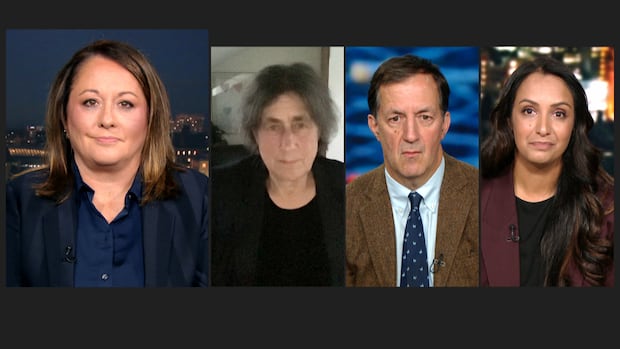
At Issue this week: Prime Minister Mark Carney moves to deepen ties with the European Union, but is it in Canada’s best interest? The Liberals try to lure foreign investment. And Stephen Harper stands behind the decision to walk away from U.S. trade talks.
Poilievre was not satisfied — he claimed that all Canadians had received from the prime minister was “grand rhetoric globally and escalating bills locally.” Carney countered that Canadians understood the rising costs were due to the war in Ukraine, the conflict in Iran, and a trade war impacting prices for consumers.
Poilievre asserted that federal policies were responsible for the high consumer prices. Carney disagreed.
The political and practical significance of such issues is hard to dismiss. “Affordability” may yet weigh heavily on the Carney administration, similar to how it affected Justin Trudeau’s government — and it could possibly rekindle Poilievre’s political prospects.
Yet, if historians reflect on the fall of 2026, it will likely be due to more dramatic events.
An impactful legislative agenda begins to take form
It wasn’t until the final inquiry of Monday’s question period — the sole chance given to an NDP MP — that the government faced a direct question regarding its significant legislative agenda.
“Well, Mr. Speaker, the true nature of this government is beginning to surface,” remarked the NDP’s Don Davies, claiming that the Liberals were poised to infringe on the right to strike with the Building Canada Strong Act.
Patty Hajdu, the jobs minister, dismissed Davies’s concerns, and shortly thereafter her colleague, Transport Minister Steven MacKinnon, introduced Bill C-39, a comprehensive 243-page legislation that alters environmental regulations, impact assessments, and labor laws.
Speaking to the press outside the House, MacKinnon labeled it the government’s “most significant economic legislation to date.”
Hajdu stated that the government was “responding to a crisis” and “doing precisely what Canadians have asked us to.”
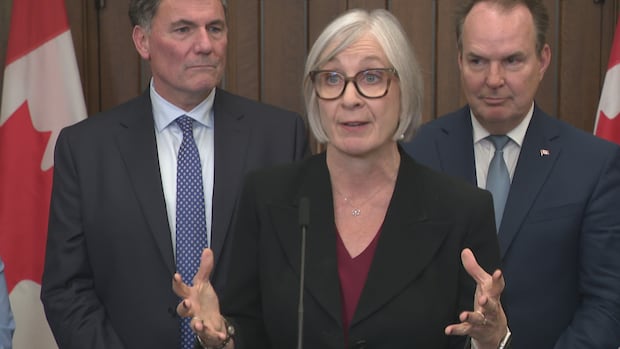
In response to a reporter who suggested that changes to the Canada Labour Code in the omnibus bill tabled by the government Monday will weaken the right to strike, Jobs and Families Minister Patty Hajdu says the bill will ‘raise the bar around accountability’ on both sides of negotiations.
If the question period is any indication, the most vocal opposition to C-39 may arise from outside the House of Commons — particularly from environmental organizations and labor unions.
Carney has amassed considerable political capital over the past year and a half. Political capital is meant to be utilized. The Carney administration has not shown much restraint until now.
However, C-39 — along with whatever significant measures may follow this fall — could put to the test how effectively this prime minister and his administration handle dissent and criticism — and how well Carney can rally Canadians around an agenda that may not always be met with enthusiasm or agreement. Even a wartime leader cannot presume public support is guaranteed.
Few would argue that this is — in one way or another — a pivotal moment for the nation. The scope of those changes remains to be discussed. The implications for the Carney administration itself are yet to unfold.