

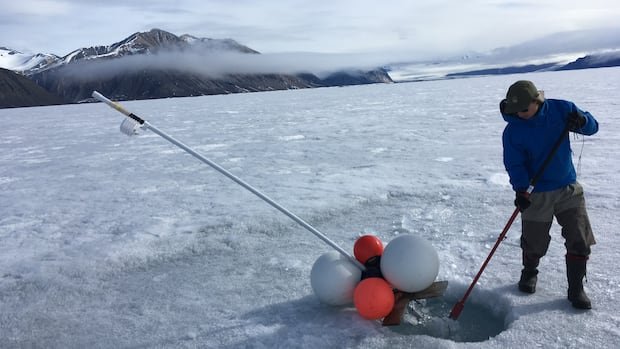

Canada’s sole remaining epishelf lake, characterized by freshwater resting atop saltwater, has vanished, along with the distinctive ecosystem it sustained, as per findings by scientists in a recent study. Jérémie Bonneau, the study’s lead author and an assistant professor at Laval University in Quebec City, expressed sorrow over the disappearance of the Milne Fiord epishelf lake on Ellesmere Island in Nunavut, noting it was the final one of its kind in Canada.
Bonneau emphasized that the complete vanishing of this once prevalent natural phenomenon underscores how a warming climate is reshaping the Arctic. Despite previous reports on the lake’s demise, the latest study, published in the journal Scientific Reports, delves into the detailed process of its disappearance, labeling the irreversible loss as a significant shift in regime marking the end of a 4000-year era.
The formation of epishelf lakes involves glaciers acting as ice rivers flowing into the sea, with any surface meltwater typically mixing rapidly with seawater due to wind and waves. However, the Milne Fiord’s freshwater accumulation was enabled by a dam formed over millennia by the Milne Ice Shelf, a massive flat ice structure extending from the north shore of Ellsemere Island. This dam prevented freshwater from entering the ocean, leading to the accumulation of freshwater atop the Arctic Ocean’s saltwater, creating a floating freshwater layer due to the lower density of freshwater compared to saltwater.
An essential characteristic of the Milne Fiord epishelf lake was its year-round ice coverage, about 50 to 100 centimeters thick, shielding the freshwater and saltwater layers from turbulent winds that could have mixed them. Research indicates that the lake had been accumulating freshwater for over 4,000 years, with the freshwater layer measuring 18 meters deep in 1983, equivalent to the height of a six-story building.
While some epishelf lakes are entirely situated on top of ice shelves, the Milne Fiord lake was linked to the ocean through an under-ice channel within the ice shelf, which had been thinning for approximately a century. The lake hosted distinct ecosystems in its freshwater and saltwater layers, with minimal overlap between the communities residing just 20 centimeters apart, showcasing a unique environmental setup not found elsewhere.
The disappearance of the Milne Ice Shelf in 2020 led to the collapse of the dam holding the lake, resulting in the rapid drainage of freshwater and the lake’s ultimate disappearance within two months. The mixing of freshwater with seawater following the collapse would have led to the instantaneous demise of freshwater organisms. While epishelf lakes are no longer present in Canada, a few still exist in Greenland and Antarctica, although their future remains uncertain due to ongoing environmental changes.
In conclusion, the loss of Canada’s last epishelf lake highlights the irreversible impact of climate change on unique ecosystems, underscoring the need for conservation efforts to preserve such natural wonders.