

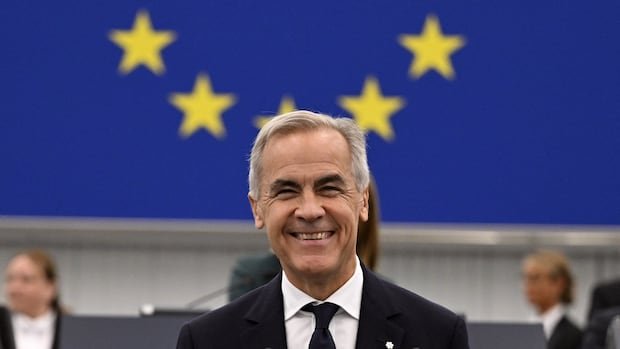

Prime Minister Mark Carney and European Commission President Ursula von der Leyen delivered speeches this week outlining the details of a proposed new partnership between Canada and the EU. Although significant information has been shared, there are still unresolved aspects to be addressed.
Carney and von der Leyen discussed the concept of Canada potentially becoming the EU’s first “associate member” or, as Carney prefers to describe it, “an alliance for the future.” Carney clarified that Canada is not seeking full membership in the EU, emphasizing this stance in his speech to the European Parliament in Strasbourg.
The specific details of what being an ‘associate member’ entails are still unclear as it is not a formal legal designation. While various versions of associate-type memberships have been proposed previously, including a recent suggestion for Ukraine, the exact nature of Canada’s potential status remains undefined.
In his address, Carney highlighted the importance of maintaining Canada’s independence while exploring enhanced collaboration with the EU. The discussions have touched on areas such as manufacturing, technology, defense, the Arctic, energy, and security, aiming to elevate the relationship between Canada and the EU.
Carney outlined key aspects of the envisioned partnership, including cooperation in critical minerals, defense industrial capacity, AI, energy security, space, digital trade, and participation in programs like Erasmus+ and Horizon. The proposed alliance is not intended to create a great-power rivalry but to serve as a model for other democracies.
Concrete details are expected to emerge at a Canada-EU summit scheduled for October in Montreal, where unresolved issues such as the potential name of the partnership, mobility changes, and approval processes by EU member states and the Canadian Parliament will be addressed. The proposal has already raised concerns among some EU diplomats, as any formalization of associate membership would require unanimous agreement among all EU countries, a challenging feat.
The existing Canada-EU free trade agreement, known as CETA, is still not fully implemented across all EU member states, underscoring the complexities of international agreements. The ongoing discussions between Canada and the EU aim to establish a robust and mutually beneficial partnership while respecting the sovereignty and interests of both parties.