

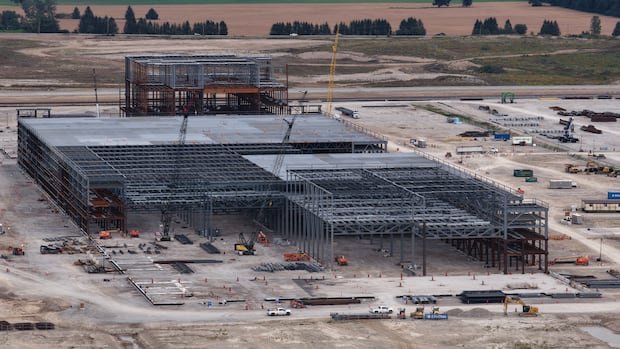

Governments at the federal and provincial levels made significant investments in the electric vehicle (EV) industry, but several key EV and battery projects across Ontario, Quebec, and British Columbia have faced delays, cancellations, suspensions, substantial changes, and even bankruptcy due to lower-than-expected demand. The most recent setback involves Volkswagen’s PowerCo battery plant in St. Thomas, Ontario, which has postponed production by two years to 2029 citing evolving market conditions.
Critics are questioning the scale and location of Canada’s EV investment approach. Grieg Mordue, a former Toyota executive and retired McMaster University professor, highlights concerns about inefficiencies in producing one million battery cells for EVs annually in St. Thomas, especially given Volkswagen’s primary assembly operations in the southern United States and Mexico.
Despite these challenges, Volkswagen emphasizes the importance of the St. Thomas plant in its North American battery strategy and plans to leverage the delay to incorporate newer battery technology and adjust production according to demand. This delay could also result in reduced government subsidies, benefiting taxpayers in the long run.
Joanna Kyriazis from Clean Energy Canada argues that the current slowdown in EV demand should be viewed as part of the industry’s transition, rather than an indication of overbuilding battery capacity. She points out a recent uptick in EV registrations in Canada, suggesting a potential market recovery.
Furthermore, the push for domestic battery production aligns with global trends, as countries seek to reduce reliance on Asian markets for battery cells. While some experts express concerns about the sustainability of current EV policies, others believe that investments in EV infrastructure and battery manufacturing are essential for Canada to remain competitive in the evolving auto industry landscape.
In conclusion, the debate continues on whether Canada’s bet on the EV market’s growth was premature or a necessary step towards a sustainable automotive future. The industry faces challenges, but the long-term vision remains focused on establishing a robust EV ecosystem in Canada.