

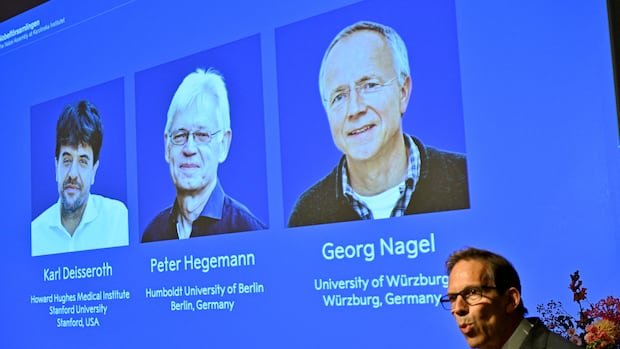

Karl Deisseroth, Peter Hegemann, and Georg Nagel were awarded the 2026 Nobel Prize in Physiology or Medicine for their groundbreaking work on light-gated ion channels and optogenetics, as announced by the Nobel Assembly in Stockholm on Monday. Optogenetics enables the precise control of individual nerve cell activity in the brain, unlocking new insights into the brain’s functions globally.
The trio, comprising Deisseroth from the U.S., Hegemann from Germany, and Nagel also from Germany, expressed their mutual admiration for each other upon receiving the prestigious award. The Nobel Prize, which includes a prize sum of 12 million Swedish crowns, will be divided among the three scientists. Deisseroth is affiliated with Stanford University, Hegemann with Humboldt University, and Nagel with the University of Würzburg in Germany.
According to Anna Wedell, a genetics professor and Nobel committee member, optogenetics marks the beginning of a transformative era in neuroscience, shedding light on how the brain processes information and the intricate interactions among neurons.
Clinical trials are demonstrating promising outcomes in restoring vision to individuals affected by retinitis pigmentosa by utilizing light-sensitive proteins in the retina. Optogenetics also holds potential for enhancing cochlear implants to deliver more precise stimulation to the auditory nerve compared to current methods.
The journey towards optogenetics began in the early 1990s when Hegemann investigated how the alga Chlamydomonas responded to light, leading to the discovery of channelrhodopsin-2, an ion channel activated by light exposure. Subsequent research demonstrated the applicability of this protein in generating electrical impulses in human and hamster cells, culminating in the development of optogenetics.
The Nobel Prizes for physics and chemistry are set to be awarded in the following days, with literature, peace, and economics prizes to follow. Established by Alfred Nobel, the prizes honor individuals who have made significant contributions to humanity. Nobel, recognized for inventing dynamite and his multilingual abilities, established the prizes to commemorate achievements that benefit society.
The laureates will officially receive their Nobel Prizes on December 10, the anniversary of Alfred Nobel’s passing.