

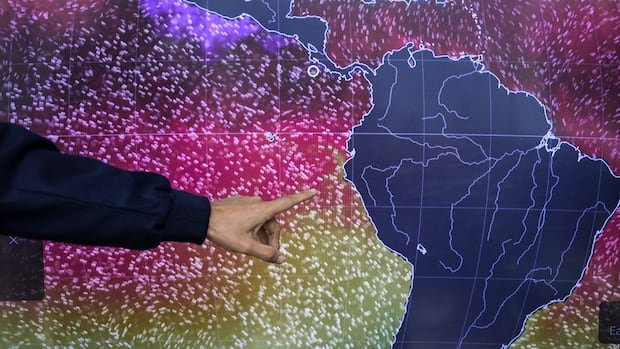

El Niño, the natural climatic phenomenon that recurs periodically and leads to global temperature spikes, is forecasted to peak in several months and continue through next spring, according to experts. Presently, discernible impacts are evident in both weather conditions and human readiness.
Here’s a visual overview of how El Niño is already influencing various aspects:
### Panama Canal Experiences Low Water Levels
A ship navigates through the Panama Canal near a hydrometeorological monitoring station on August 27, amid decreased rainfall linked to El Niño affecting water levels in Gamboa, Panama. The Panama Canal Authority has limited daily transits starting in early September due to the prolonged El Niño season.
### Displaced Seabirds
Blue-footed boobies gather on rocks near the entrance to the Panama Canal on August 5. The presence of seabirds in increased numbers near Panama City is attributed to El Niño warming the eastern Pacific and disrupting marine food sources.
### Preparations Across Latin America
Governments across Latin America are mobilizing firefighters, implementing contingency plans, and fortifying water, energy, and transportation systems as El Niño intensifies across the Pacific. Concerns about drought, extreme heat, flooding, and other climate-related disruptions in the upcoming months have prompted proactive measures.
In Honduras, the Secretariat of Risk Management and National Contingencies has issued red alerts in 75 municipalities in central and southern regions and yellow alerts in 71 other municipalities due to adverse climate conditions affecting agriculture and livestock. Police officers ride past a drought-affected cornfield on August 26.
Unlike sudden natural disasters, El Niño develops gradually over months, allowing governments time to prepare for its severe impacts. In Peru, President Keiko Fujimori has prioritized readiness for El Niño. She is seen here on July 9 with Lima Mayor Renzo Reggiardo during a river cleaning operation on the Rímac River as a preventive measure against El Niño-induced heavy rainfall.
### Indonesia Faces Extreme Heat
In Indonesia, salt farmers in West Java province are benefiting from a drought driven by El Niño, while crop farmers anticipate prolonged challenges from the scorching temperatures. Villagers collecting spring water in Cilegon, Indonesia, on July 17, highlight the struggle to access groundwater at their homes due to the anticipated intensified and extended dry season influenced by El Niño.
El Niño has already set intensity records in its initial phases and is expected to escalate global erratic weather patterns, as warned by United Nations officials. While not directly causing Indonesia’s severe wildfire season, El Niño exacerbates the situation by providing favorable conditions for rapid fire spread. Firefighters commemorate Indonesia’s Independence Day in an area affected by forest and land fires in Palangkaraya on August 17.
Furthermore, in Canada, models indicate a warmer-than-usual winter nationwide due to El Niño, with British Columbia’s wet south coast possibly experiencing reduced precipitation and snowpack levels. El Niño typically translates to fewer tropical storms in the Atlantic.
For insights into the potential impacts of El Niño on Canada, watch the video provided.
[Source](https://www.cbc.ca/news/world/el-nino-effects-drought-storm-surge-weather-9.7326585)