

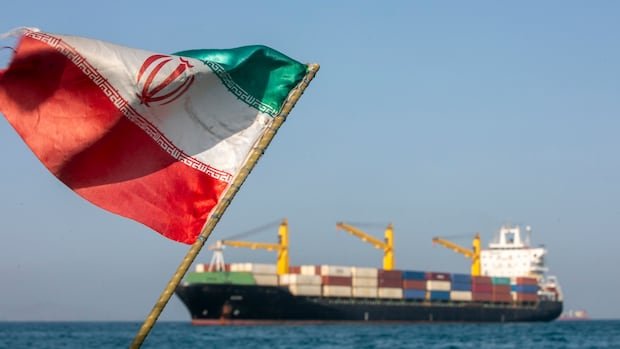

U.S. military forces carried out an operation on Sunday by targeting Iranian rocket launchers in the Strait of Hormuz, marking the first military engagement in over a month. The action disrupted a period of relative calm in the ongoing conflict that has persisted for more than six months. Intelligence sources reported that Iran’s Islamic Revolutionary Guard Corps (IRGC) were seen preparing to deploy rockets armed with sea mines in the strait. Notably, the U.S. military had recently completed a mission to clear sea mines from the international shipping lanes in the area.
Reports from semi-official Iranian news sources indicated hearing explosions near Larak Island in the strait. Subsequently, Iranian state television broadcast footage purporting to show ballistic missiles being launched at U.S. bases in Jordan as a retaliatory measure against the American strikes. Jordan’s armed forces stated they intercepted eight missiles that entered the country’s airspace early Monday.
Contrary to Iran’s assertions that the U.S. strikes were aggressive, American military officials described the operation as a “limited, precise action” aimed at thwarting alleged minelaying activities. The U.S. Central Command emphasized that the military’s intervention was necessary to safeguard civilian mariners, commercial shipping, and the unimpeded flow of global trade.
The escalation in hostilities follows a recent shift in the Trump administration’s approach towards Iran. The administration signaled a pivot towards leveraging economic pressure instead of continued military actions to resolve the conflict. This strategic adjustment focuses on imposing sanctions on entities engaging in business with Tehran. Concerns have arisen regarding dwindling munitions supplies and the potential impact on U.S. military readiness in other regions due to the protracted conflict.
President Trump’s earlier optimism about swiftly resolving the war seems to be waning as the conflict persists. He has expressed a lack of urgency in returning to negotiations with Iran and highlighted the perceived weakening of the Iranian leadership. While Trump and Israel claim significant damage inflicted on Iran’s military capabilities, Iranian officials contend that the country has suffered substantial financial losses. Despite these setbacks, Iran maintains influence through its actions in the critical Strait of Hormuz, a key chokepoint for global oil shipments.
Trump’s assertions that the strait remains open clash with reports indicating reduced commercial traffic levels in the area. Recent incidents, including the striking of a tanker ship by an unknown projectile near Khasab, Oman, have underscored the ongoing tensions in the region. The United Kingdom Maritime Trade Operations reported no casualties or environmental damage from the attack on the inbound vessel, with no immediate claims of responsibility.