

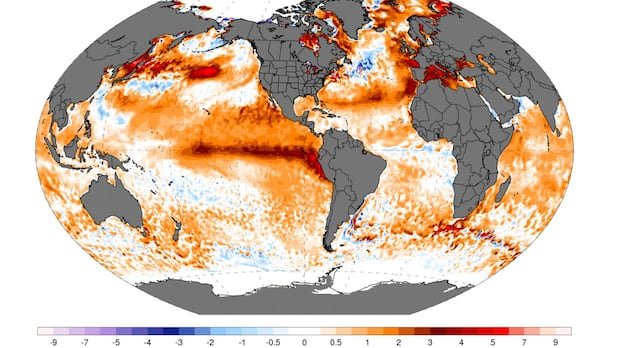

The highly anticipated El Niño has finally arrived, and it is already proving to be as powerful as predicted. Earlier this year, climatologists had projected the development of an El Niño in the central Pacific region. Subsequently, models began indicating the likelihood of a strong or “super” El Niño, although it was cautioned that certainty was premature.
In June, the U.S. National Oceanic and Atmospheric Administration (NOAA) released its monthly update, officially declaring an El Niño advisory as warmer conditions emerged in the specific Niño 3.4 region of the Pacific Ocean. To meet the El Niño classification, temperatures in this zone must exceed 0.5°C above average. Current ocean temperatures are approaching nearly 2°C above average, setting a record high for this time of year.
Zeke Hausfather, a climate scientist at Berkeley Earth, noted that temperatures in the Nino 3.4 region have surpassed 2°C, indicating the potential for a very strong or “super” El Niño. The peak of this El Niño event is expected around October, with some models suggesting a peak in November or December, signifying uncharted territory for the year.
El Niño and La Niña are part of the El Niño Southern Oscillation (ENSO) cycle, impacting the Pacific Ocean region. While La Niña brings cooler temperatures, El Niño ushers in warmer conditions. The shift from La Niña to El Niño has been swift this year, with notable temperature anomalies.
The previous record El Niño in 2015-2016 recorded an anomaly of approximately 2.75°C. Nat Johnson from NOAA highlighted the rapid transition from La Niña to El Niño within a year, attributing the change to unknown factors. The possibility of a 4°C anomaly was initially met with skepticism but has become increasingly plausible over time.
The influence of climate change on these extreme events remains uncertain, with ongoing debates among scientists. Concerns about food security in tropical regions and potential impacts on agriculture and ecosystems are heightened as the El Niño unfolds. In Canada, milder winter temperatures and drier conditions are expected, raising concerns about wildfire risks in Western Canada.
As the El Niño event progresses, the implications on various sectors are being closely monitored, highlighting the significance and potential consequences of this natural phenomenon.