

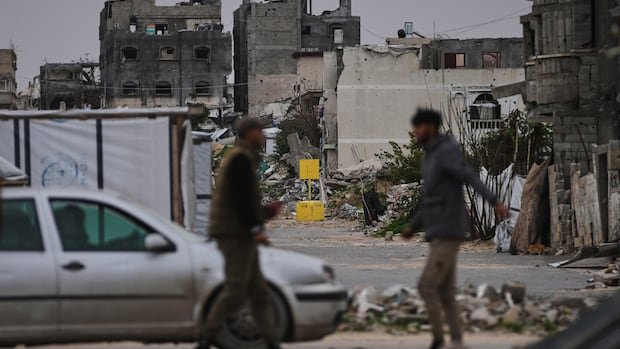

On a Gaza coastal area resembling a holiday destination rather than a conflict zone, Palestinians enjoy the sunny weather. Despite discussions about peace negotiations and withdrawals, few are optimistic that the situation has been resolved.
“This war has made me hesitant to hope,” remarked Tamer Al-Sheikh. “We’ve had hope during several truces, but the conflict persists.”
Israeli airstrikes target Gaza nearly every day, aiming at Hamas militants wanted by Israel. Simultaneously, Israeli forces are advancing westward, expanding their military presence and pushing two million Palestinians into a shrinking space, leading to a struggle for survival towards the Mediterranean Sea.
Following the Gaza peace agreement last October, Israel agreed to withdraw its troops behind the “yellow line,” marking the limit of Israeli military control within Gaza. However, the Israeli army now controls over 60%, citing the need for “operational security.” Israeli Prime Minister Benjamin Netanyahu has instructed his generals to extend control to 70%.
In a recent development, Netanyahu rejected a U.S. proposal to gradually remove Israeli military and Hamas militant control in Gaza, insisting on disarmament of Hamas before any withdrawal. The deadlock remains as Hamas is willing to surrender weapons only alongside Israeli pullback phases.
Visual investigations by CBC have confirmed the continuous advancement of Israeli troops and expansion of the yellow line in Gaza through satellite imagery and eyewitness reports.
The impact on Gaza’s civilians has been severe. Palestinians wake up to find the yellow markers moved closer to their homes overnight, signaling the presence of Israeli forces. Many have been forced to relocate multiple times due to escalating hostilities.
Moreover, the systematic destruction of Gaza’s neighborhoods has been observed through satellite images, with more homes being demolished by Israeli forces since the ceasefire began. UN experts have criticized Israel’s demolition of residential buildings as an attempt to reshape Gaza’s geography.
Despite Israeli claims that the movement of the yellow line aligns with the ceasefire terms, there are concerns about the impact on Palestinians’ lives. Israeli authorities have constructed barriers and fortified compounds along the yellow line, raising tensions in the region.
Extremist Israeli groups have expressed desires to annex Gaza, with some cabinet members advocating for Jewish settlements in the area. The political landscape is tense, with elections approaching and Netanyahu facing a tough re-election battle. The situation remains precarious for Palestinians living near the advancing yellow line, raising fears of further displacement and conflict.