

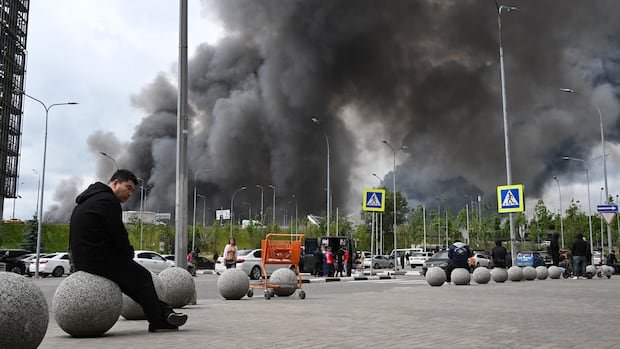

Last week, residents of Moscow witnessed dark smoke looming over the city while Ukrainian drones flew above. It marked Ukraine’s most significant drone attack on the Russian capital since Russia initiated a full-scale invasion in 2022. The series of strikes caused numerous flight delays and cancellations, with a major oil refinery on the outskirts of the city being repeatedly targeted and set ablaze.
Ukrainian President Volodymyr Zelenskyy warned, “If Ukraine burns, Moscow will burn too.” This recent wave of attacks has brought the war closer to home for many Russians, disrupting daily routines and undermining their sense of security. Analysts suggest that these strikes could heighten internal anxieties as the conflict prolongs, though the impact on Russian President Vladimir Putin’s authority remains uncertain.
Historian Anne Applebaum highlighted that Muscovites were experiencing real drone warfare for the first time since the conflict began. She emphasized that these attacks might not immediately end the war but could significantly shift the mood among influential figures who affect Putin’s decisions.
Despite the visible impact of the attacks, the footage was not aired on evening news broadcasts, and there were no alerts issued to residents. This lack of communication left many feeling anxious and unprotected in the face of the escalating conflict.
In addition to Moscow, other Russian cities have also been targeted by Ukrainian strikes. Recent incidents include the targeting of an electronics plant in Voronezh, Russia, and power outages in Crimea, along with attacks on energy infrastructure in central and southern Russia. The repercussions have led to fuel restrictions in Crimea, further exacerbating the situation.
As some Russian nationalist figures voice criticism of Putin’s handling of the war, their discontent does not necessarily reflect a shift in support for the conflict itself. The complexities of Russian society’s views on the war and Putin’s leadership underscore the ongoing challenges faced by the country amidst escalating tensions.
The possibility of Putin resorting to extreme measures in response to domestic discontent and the prolonged war poses a significant concern. The dynamics within Russia, coupled with the escalating conflict, create a precarious situation for Putin’s administration and the country as a whole. The mounting pressure on Putin, both domestically and internationally, presents a complex scenario with uncertain outcomes.