

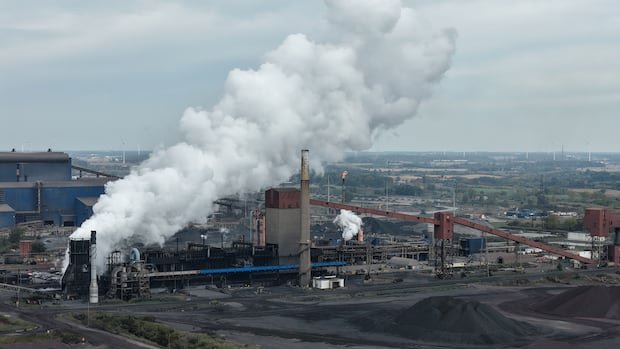

Stelco Holdings has a limited timeframe to present a strategy to prevent numerous steelworkers in Ontario from facing ongoing job cuts — or it could encounter legal repercussions from the Canadian government.
This situation is seen as a crucial test of accountability for foreign investors as Prime Minister Mark Carney endeavors to attract more of them to Canada amid a contentious trade dispute with the United States.
Reflecting on the past, in 2007, U.S. Steel from Pennsylvania disclosed a deal to acquire Stelco, then a publicly traded entity, for approximately $1 billion US, subsequently rebranding the company as U.S. Steel Canada.
Under the Investment Canada Act, significant foreign investments should positively impact the local economy. Thus, foreign purchasers are required to provide binding written commitments to the federal industry minister to demonstrate that the deal brings a “net benefit to Canada.”
Despite commitments made by U.S. Steel, such as maintaining Canadian employment levels for three years and boosting steel production by at least 10 percent in Canada, the 2008 financial crisis led to the closure of most of Stelco’s Canadian facilities, resulting in over 1,500 job losses.
The attorney general of Canada initiated a lawsuit against U.S. Steel in July 2009, marking the sole instance where Ottawa resorted to legal action over such commitments. Stelco contended that the undertakings only required compliance at the end of their three-year term, not sooner. Additionally, as per Industry Canada guidelines, external factors like the financial crisis should not hold investors accountable.
In late 2011, the lawsuit was formally withdrawn, culminating in an out-of-court settlement where U.S. Steel committed to sustaining production in Hamilton and Lake Erie, along with making $50 million in new capital investments by 2015 to modernize operations. However, in 2014, U.S. Steel Canada sought creditor protection, leading to the severance of ties with its Canadian operations by the American parent company.
Subsequent developments in 2016 saw a New York-based private equity firm acquire the steelmaker, reviving the Stelco name upon its return to the Toronto Stock Exchange the following year. This dispute prompted amendments to the Investment Canada Act to facilitate settlement negotiations and enhance enforcement.
Fast forward to 2024, Cleveland-Cliffs, based in Ohio, received approval from Ottawa for its $3.4 billion cash-and-stock acquisition of Stelco, subject to conditions like maintaining current employee levels for five years. Recently, Stelco announced plans to halt certain production, leading to potential company-wide layoffs.
Cleveland-Cliffs CEO justified the layoffs citing the Canada-U.S. trade war, emphasizing the necessity to sell steel to the U.S. as part of the deal. However, Industry Minister Mélanie Joly issued a five-business-day ultimatum to Stelco to disclose a job-saving plan or face legal repercussions. Joly criticized Goncalves for supporting American steel tariffs, emphasizing that changing market conditions do not nullify prior commitments.
Speculations suggest that the matter may head to court, with potential outcomes ranging from a settlement to enforced commitments or a sale of the business. The situation presents challenges for the Canadian government’s investment agenda, particularly amidst efforts to attract substantial investments and reduce dependency on the U.S. market. Balancing accountability and economic interests remains a complex task for policymakers.