

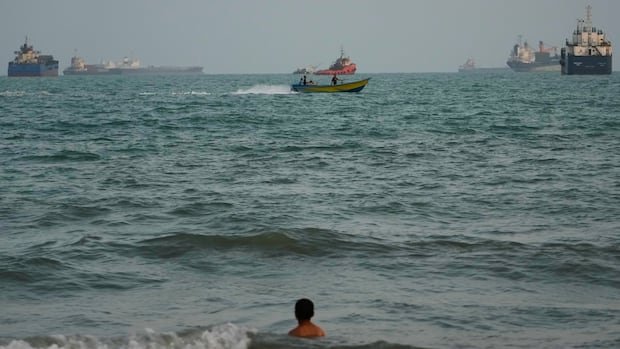

Iran’s new leader of the Supreme National Security Council has announced plans to establish an “exclusion zone” outside the Strait of Hormuz to target vessels attempting to pass through the waterway. Mohsen Rezaei revealed this information to Iran’s state broadcaster without providing many specifics. This announcement follows the U.S. striking three Iranian oil tankers in response to Tehran’s ballistic missile launch towards American warships. Experts view these actions as a risky escalation, especially after Iran’s previous attacks on commercial shipping.
The proposed exclusion zone is expected to be formally declared in the upcoming days and weeks. Rezaei outlined that the zone would start from the U.S. naval blockade line, extend towards the Strait of Hormuz, and continue into the Persian Gulf. He warned that any ship identified within this area with intentions to transit the strait will face sanctions.
The exact location of the weeks-long U.S. blockade targeting Iranian ports remains unclear. The U.S. military has reported deploying over 20 warships to enforce the blockade, redirecting 92 commercial vessels and disabling three as of the latest update on Sunday. Amidst failed negotiations and ongoing sporadic conflict, the U.S. is implementing new measures to increase economic pressure on Iran.
In a separate development, Iran alleges striking an unmanned U.S. vessel attempting entry into the Strait of Hormuz, a claim swiftly dismissed by the U.S. military as a “total lie.” This incident adds to the recent escalation between the two nations, with continued hostilities since the conflict began over six months ago. In response, Canada’s Foreign Affairs Minister Anita Anand condemned Iran’s destabilizing activities and vowed to work with global partners to maintain pressure on Iran.
The recent skirmishes come after a period of relative calm, with renewed attacks in the Strait of Hormuz and nearby Iranian regions. The Trump administration appears to be employing a dual strategy of military responses to strait-related incidents while targeting foreign financial institutions handling Iran’s finances. Meanwhile, Iran’s new hardline leadership signals a readiness to withstand sanctions and maintain its position.
Despite efforts to circumvent sanctions and the U.S. blockade, Iran continues to face economic challenges. The unresolved issue of Iran’s nuclear program, a key factor in the conflict’s onset, remains unresolved following the breakdown of negotiations. Diplomatic sources indicate that the U.S. and European countries are considering involving the United Nations Security Council due to Iran’s alleged non-compliance with nuclear agreements.
The strategic importance of the Strait of Hormuz as a global trade route for oil and gas shipments remains paramount. U.S. Energy Secretary Chris Wright highlighted that an average of nine million barrels of oil pass through the strait daily, potentially easing energy price concerns. However, the uninterrupted flow of oil depends on the U.S. navy’s escort services to protect tankers from potential Iranian threats. Despite challenges, Iran maintains that its oil production and trade activities continue relatively unabated.
As tensions persist and diplomatic efforts falter, the situation in the region remains volatile, with both the U.S. and Iran engaging in tit-for-tat actions that could further escalate the conflict.