

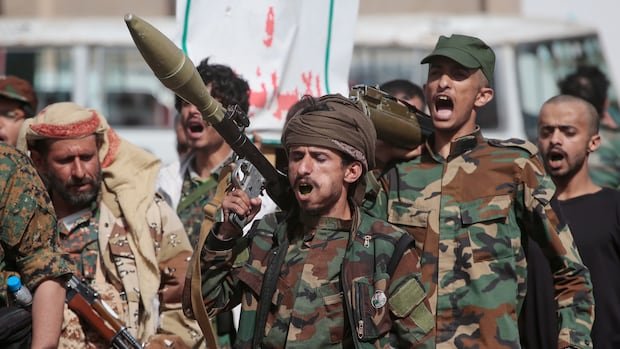

Almost three years following the global spotlight on the Houthis for their assaults on commercial vessels near Yemen, the rebels have expanded their violent impact in the Middle East.
The Houthis, a faction involved in the Yemeni civil war that claimed over 100,000 lives before a fragile truce in 2022, have been at odds with Israel, Saudi Arabia, the U.S., and international maritime trade routes, potentially driving up global oil prices.
Originating in the 1990s, the Houthi movement emerged in far-north Yemen as a religious revival movement for the Zaydi sect of Shia Islam, historically dominant in Yemen. The conflict in Yemen escalated in 2014 when the Houthis seized control of Sanaa, the capital city.
In early 2015, Saudi Arabia, supported by other Gulf nations and the U.S., commenced airstrikes against the Houthis, who are backed by Iran. The ensuing proxy war inflicted severe humanitarian consequences on Yemen, with casualties surpassing 150,000 and a dire impact on the population’s well-being.
Although violence decreased after a UN-mediated ceasefire in April 2022, the Houthis redirected their aggression towards Israel and Red Sea shipping lanes following an attack by Hamas in Gaza on October 7, 2023. These assaults on maritime traffic resulted in the sinking of two vessels and the loss of four sailors by the end of 2024.
The recent breakdown of the 2022 truce signifies a potential return to civil strife in Yemen, with implications for global commodity prices. The fragile calm shattered in July when the Houthis resumed attacks on Saudi Arabia in response to a Saudi airstrike on Sanaa’s international airport, disrupting regional stability.
The Houthis’ incursion has extended to the strategic island of Perim in the Bab al-Mandab Strait, a crucial global shipping route comparable to the Strait of Hormuz, a focal point of contention between Iran and the U.S. The Houthis’ control over the Bab al-Mandab could disrupt energy and shipping flows, impacting Gulf countries’ economies.
The Houthis, not merely Iranian proxies but aspiring partners, aim to establish a strict Shia theocracy across Yemen, challenging U.S. influence in the region. The economic fallout from their actions has led to record-high tanker shipping costs and elevated global oil prices above $100 per barrel.
As tensions escalate, Saudi Arabia seeks U.S. support against the Houthis, while Iran may leverage the Bab al-Mandab Strait to pressure the U.S. However, the Houthis may opt for a less confrontational approach to avoid retaliation, underscoring the complex dynamics at play in the region.