

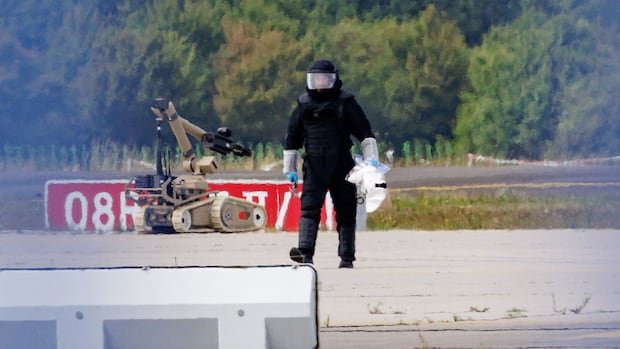

The German government has pointed fingers at Russia for an attempted drone attack at Leipzig/Halle Airport in August, leading to the decision to close a Russian consulate and take other actions against Moscow. The drone, discovered near a Ukrainian aircraft on August 4, was found to be carrying explosives and was successfully defused, raising concerns about heightened danger.
German officials have accused Moscow of engaging in a campaign of sabotage and disruption across Europe to undermine support for Ukraine and destabilize European nations. German Interior Minister Alexander Dobrindt highlighted similarities between the drone used in the attack and tactics seen in Russia’s operations against Ukraine, suggesting a high level of technical expertise and meticulous planning.
Authorities assert that individuals acting on behalf of Russian state entities were involved in the attempted attack. Foreign Minister Johann Wadephul condemned the incident as a deliberate move by Russia to damage bilateral relations further, leading to the closure of the Russian consulate in Bonn and the Russian House cultural center in Berlin.
Germany plans to propose adding more Russian individuals to EU sanctions lists in response to hybrid attacks, enhance entry controls for Russians, and increase scrutiny on suspected tankers transporting Russian oil in violation of sanctions. The Russian ambassador was summoned to the Foreign Ministry in Berlin to address the situation.
Russian officials have denied involvement in the drone attack, dismissing the accusations as baseless and claiming a lack of substantial evidence. Russian President Vladimir Putin refuted the allegations, suggesting that Germany fabricated evidence to divert attention from internal issues and portray Russia negatively.
Leipzig/Halle Airport serves as a crucial hub for international freight and support to Ukraine, hosting NATO operations and strategic airlift missions. The region has experienced security incidents in the past, including an attempted attack on a logistics center in 2024 linked to Russian intelligence activities.
The European Union has imposed multiple rounds of sanctions on Russia following its actions in Ukraine, with NATO expressing full solidarity with Germany in the aftermath of the Leipzig incident. Western nations, including Canada, have pledged support to Germany and Ukraine amidst escalating tensions with Russia.
Germany is working on expanding intelligence services’ powers to counter threats like sabotage and hacking attempts, with recent reports of similar incidents in Poland raising concerns about foreign interference. The Polish government reported acts of sabotage, including arson, targeting critical infrastructure and key industries, prompting investigations into potential foreign intelligence involvement.