

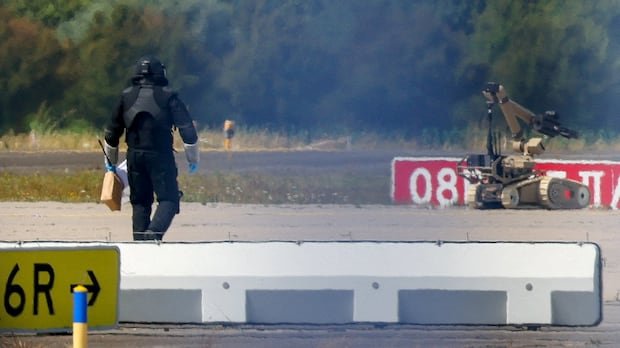

German authorities are currently investigating a drone containing explosives and a detonator discovered at Leipzig airport, while Russian Foreign Minister Sergey Lavrov has indicated Russia’s intention to escalate retaliation against countries supporting Ukraine.
In an interview with VGTRK, Russia’s state media, Lavrov stated, “We will employ more severe measures to dismantle everything that aids the West in supporting Kyiv’s war efforts. We are already taking action.”
The drone, carrying an unidentified explosive device, was found by an airport employee in the security area of the cargo operations zone near the south runway of Leipzig airport, which is considered critical infrastructure. Leipzig serves as a strategic NATO airport used for transporting armaments, ammunition, weapons, and other military supplies to Ukraine through flights operated by Ukrainian cargo companies.
The incident of the drone, discovered near a Ukrainian cargo plane, represents a heightened threat level for Germany, according to the country’s interior minister, Alexander Dobrindt. Dobrindt mentioned that the nature of the incident suggests a sophisticated and professional hybrid threat scenario rather than an amateur effort.
While German authorities are probing the incident and have not disclosed the drone’s origin, U.S. intelligence officials informed the Wall Street Journal that intelligence reports link the drone to the Russian government.
Amid the ongoing investigations, Berlin is cautiously responding by enhancing anti-drone capabilities and refraining from premature attributions. Dobrindt emphasized the importance of gathering factual information before making official statements.
Dobrindt highlighted that Germany faces relentless hybrid warfare activities on a daily basis, encompassing espionage, sabotage, cyber attacks, and covert operations orchestrated by foreign entities to destabilize the country and induce political and social changes.
Recent revelations include a Russian plot to assassinate the CEO of German defense contractor Rheinmetall in 2024 and the arrest of a suspected Russian spy scouting sabotage targets related to Berlin’s military support for Ukraine earlier this year. The Institute for Strategic Dialogue (ISD) has been monitoring Russia’s online interference in Germany through Operation Overload, aiming to exploit emerging controversies within NATO member countries and Ukraine, particularly focusing on Germany, France, and Ukraine, with the goal of undermining Ukraine’s war efforts and destabilizing democracies.
Dobrindt acknowledged the presence of disinformation campaigns targeting German politics and society, especially during regional elections. Hans-Jakob Schindler, senior director of the Counter Extremism Project, characterized the drone incident in Leipzig as an aggressive escalation of Russia’s interference tactics, testing Germany’s tolerance levels.
Schindler raised concerns about the blurred line between defense and direct conflict, emphasizing the need to establish clear boundaries with Russia to prevent further escalations. Lavrov’s recent statements were interpreted as a shift from past denials of Russia’s involvement in Western countries, signaling a more aggressive stance against Europe, the West, and NATO, according to Schindler.