

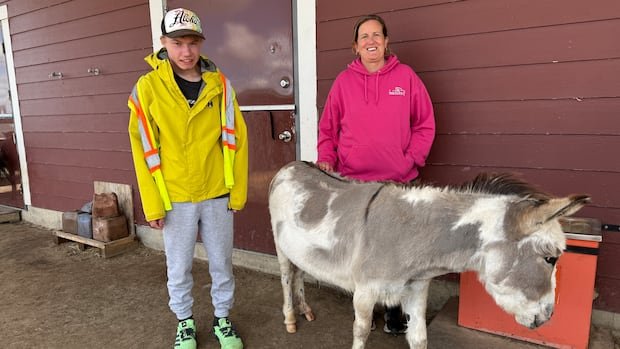

On a dusty path in the countryside of Saskatchewan, a working farm buzzes with activity, boasting two residences, a crimson barn, a workshop, a communal dining area, and a greenhouse. In the warmth of an August day, individuals with cognitive challenges engage in gardening tasks. While some women harvest beans, a small cluster of men tends to the corn and potato crops.
Lynne Cammidge, a 52-year-old resident at Farm in the Dell, expresses contentment with her surroundings. She reflects, “I find it very serene. When I first arrived here, I was amazed by the beauty of this farm.” Cammidge was among the initial residents to transition to this rural group home 15 years ago. She shares, “My parents were aging, and they felt it was best for me to relocate here. I explored a group home in Saskatoon, but it didn’t suit me.”
Farm in the Dell, a non-profit organization, offers individuals with cognitive disabilities a purposeful routine and a rural setting. Situated approximately 45 kilometers northeast of Saskatoon near Aberdeen, Sask., the farm provides a range of tasks such as weeding and watering, allowing the residents to care for their living environment with pride, as highlighted by Shauna Dollansky, the site manager in Aberdeen.
Many residents have a background in farming or rural living and seek to maintain that lifestyle into adulthood. Dollansky emphasizes the significance of this connection, stating, “It provides a sense of purpose and a link to the land.” The Farm in the Dell model originated in the United States in 1986 and has since expanded globally, with locations in various countries.
In Aberdeen, the farm was established in 2010, comprising two residences accommodating seventeen clients. The facility is supported financially by the Ministry of Social Services through Community Living Service Development, employing around 40 staff members in full-time and part-time roles.
Executive director Lynette Zacharias emphasizes the community aspect of the farm, noting that it fosters a sense of belonging and friendship among residents, who function as a cohesive family unit. Additionally, the facility welcomes clients from Saskatoon and surrounding areas to participate in day programs, enhancing their social engagement and activities.
Residents at Farm in the Dell engage in a range of activities, including caring for various animals such as alpacas, donkeys, miniature horses, goats, pigs, rabbits, and cats. They also manage two chicken coops, collecting and washing eggs for consumption. The farm’s produce, including vegetables and eggs, is utilized in meal preparation, creating a self-sustaining ecosystem within the community.
The success of the Aberdeen farm led to the establishment of a second group home in Biggar, Sask., with ten residents and about 15-20 employees. Farm in the Dell envisions further expansion into additional communities to provide essential support and services to more individuals in need.
The organization relies on annual funding of approximately $3 million from the Ministry of Social Services to operate both locations, serving as part of the broader initiative to provide residential spaces for adults with cognitive disabilities. The province is currently constructing ten new group homes, including one tailored for clients with intellectual disabilities requiring enhanced medical support, with completion expected in the coming years.