

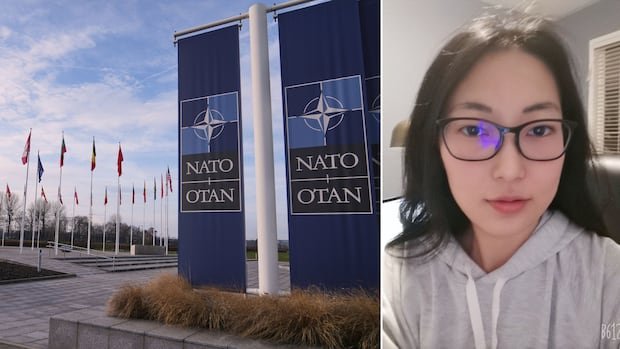

Several intelligence agencies in the West were caught off guard this summer as they tried to determine the extent of information accessed by a Canadian intern accused of spying at various agencies and government departments. Biwei Zhang, the intern at NATO’s military headquarters in Mons, Belgium, was apprehended by Belgian authorities in July for suspected espionage activities and communication with a foreign criminal entity. She has been in pretrial detention since her arrest and was recently denied an appeal for release.
Belgian authorities have been tight-lipped about the case, refusing to disclose her identity. However, a CBC News investigation managed to identify Zhang through public records, revealing her background of moving between prominent organizations over the past decade. She has held positions as an economist at Statistics Canada, a systems engineer at the Canadian Space Agency, and roles at the European Space Agency in Italy and the World Trade Organization in Switzerland.
While Belgian officials have not explicitly named the country Zhang was allegedly spying for, intelligence sources suggest it was China. The Canadian Security and Intelligence Service (CSIS) has confirmed its involvement in overseeing a comprehensive damage assessment across multiple departments in response to the espionage allegations.
In light of the incident, scrutiny is focused on the potential security breaches and the nature of Zhang’s connections, prompting concerns about the depth of her access, the extent of any damages caused, and the possibility of a wider network involvement. The public discourse in Canada has gravitated towards the security clearance process, with parliamentary hearings planned to address the issue.
Intelligence experts are primarily concerned with understanding the full scope of Zhang’s activities, evaluating the information she may have acquired, and investigating any potential accomplices. The assessment seeks to uncover her affiliations, communication channels, and operational methods.
The aftermath of Zhang’s arrest has triggered a thorough examination of security protocols and data retention practices at the agencies she was associated with in Europe and Canada. Questions linger about the availability of security logs and camera footage that could shed light on her movements and unauthorized activities within these organizations.
As the investigation unfolds, there is a growing emphasis on determining whether Zhang was directly working for Chinese military intelligence or collaborating with a third-party criminal organization. Reports suggest that European networks, including certain community associations, have been linked to Chinese intelligence activities. Authorities are also exploring the role of informal consular networks providing support to Chinese nationals in Belgium.
In Canada, authorities are delving into the potential impact of Zhang’s access to sensitive data within military and intelligence sectors. Her past roles, including tracking shipping data at Statistics Canada, raise concerns about the economic and strategic implications of the information she may have accessed.
Experts highlight the distinct approach of Chinese cyber espionage, characterized by stealth tactics aimed at long-term infiltration rather than immediate data theft. The focus is on implanting malware in critical systems for future exploitation or creating vulnerabilities for external hackers to exploit.
The ongoing investigation is uncovering additional details, including Zhang’s suspicious behavior around restricted military facilities and her interactions with personnel, which have raised suspicions of possible accomplices. The case continues to raise diplomatic and security concerns, as authorities work to unravel the complex web of espionage activities involving the Canadian intern.