



On Monday, Prime Minister Mark Carney’s administration introduced an extensive bill aimed at expediting the approval process for significant projects, shortening review durations, and establishing areas of “national interest” to pre-authorize specific types of initiatives.
The legislation, known as Bill C-39, titled the Building Canada Strong Act, also seeks to implement substantial modifications to collective bargaining practices, including increased federal mediation to facilitate agreements and enhance relations between labor unions and employers.
Transport Minister Steven MacKinnon stated at a press briefing, “This law will equip our nation with the necessary tools to construct more projects, improve quality, and enhance efficiency. We recognize the challenges we face. While we cannot influence decisions from other nations, we can determine our preparedness domestically. This necessitates appropriate infrastructure.”
High-ranking government officials who briefed the media indicated that the suggested “regions of national interest” would treat projects similarly to those designated as national interest. This includes mandating consultations prior to an area being designated and, if designated, permitting special exemptions from numerous laws.
-
New major projects bill, rowdy question period kick off Parliament’s fall sitting
-
Analysis
A consequential fall begins for the Carney government
In May, two discussion papers indicated that Ottawa was looking to establish “economic zones.” Such zones would empower the federal cabinet to determine permitted activities and grant ministers the authority to pre-approve projects within those zones.
While the discussion papers emphasized certain types of projects, including transportation corridors, telecommunications infrastructure, and energy generation and transmission, the proposed bill broadly allows various projects to be included in these zones.
Additionally, the legislation aims to transfer the responsibility for reviewing numerous large-scale projects, like pipelines and electricity transmission lines, away from the Impact Assessment Agency of Canada.
The Canada Energy Regulator would oversee reviews for international and interprovincial pipelines, transmission lines, and offshore renewable energy projects, while the Canadian Nuclear Safety Commission would handle nuclear and uranium project assessments.
The federal government indicated that during discussions on the bill, industry representatives noted that the level of expertise available for energy projects at the Canada Energy Regulator was not matched at the Impact Assessment Agency.
-
Carney government planning changes to speed up project approvals
-
Ottawa proposes suite of measures to complete review within 1 year
Dominic LeBlanc, the minister responsible for eliminating barriers to internal trade and promoting nation-building initiatives, stated, “None of this undermines environmental assessments or obligations to Indigenous rights holders. What it conveys to Canadians, workers, investors, and communities is that we will conduct this work far more efficiently and with greater significance. The current economic situation necessitates that level of diligence.”
According to senior government officials, the proposed legislation would revise the Impact Assessment Act to establish one-year federal review timelines, while the timelines for small and medium projects under the Energy Regulator and Nuclear Commission would be shortened from one year to six months.
Initiatives designated as having national interest or those located within national interest zones could commence construction prior to obtaining all requisite federal permits.
LeBlanc mentioned in French, “It’s very restricted, it’s very limited,” adding that such construction would be classified as “preparatory work” and permitted only under exceptional circumstances.
He elaborated, “In some instances, it may involve site preparation; it is not about commencing a project. If it breaches project conditions, it could be halted. If we’re discussing a minor project for preliminary research on a site to prepare payment schedules for potential construction, it will occur only in exceptional cases.”
The government had initially planned to present the bill in the spring but postponed it after receiving backlash from environmental and Indigenous groups.
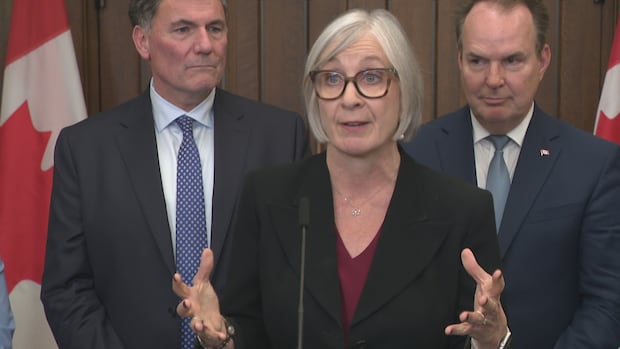
In response to a reporter who suggested that changes to the Canada Labour Code in the omnibus bill tabled by the government Monday will weaken the right to strike, Jobs and Families Minister Patty Hajdu says the bill will ‘raise the bar around accountability’ on both sides of negotiations.
The legislation underwent thorough consultations over the summer, with Ottawa receiving over 21,000 emails related to it.
Earlier this month, the government announced it had abandoned plans to exempt specific projects from laws designed to safeguard species at risk, following significant negative feedback during consultations.
The Building Canada Act — enacted as part of the contentious Bill C-5 last summer — still provides Ottawa the authority to permit projects with a “national interest” designation to bypass a dozen laws, including the Species At Risk Act.
Environmental organizations criticized the bill’s content on Monday.
Julia Levin, associate director of national climate at Environmental Defence, stated, “The government is essentially proposing that we ignore significant risks when initiating projects by undermining federal responsibility for project reviews.”
-
Carney government dealt an early blow in climate litigation
-
MPs are heading back to Parliament Hill. Here’s what to watch this sitting
She added, “This will leave Canadians unaware of risks to their communities, wildlife, and nature. It would also hinder the government’s ability to effectively consult Indigenous communities on major projects, which is constitutionally required.”
In June, as environmental groups lobbied against the proposals on Parliament Hill, Carney asserted that the government was “absolutely not” abandoning environmental protections.
The bill also suggests modifications to labor regulations in Canada.
According to senior government officials, the proposed legislation would mandate that collective bargaining commence six months prior to the expiration of a collective agreement, but only in cases where the existing agreement exceeds five years or if prior bargaining rounds resulted in a work stoppage.
Furthermore, the bill would require companies and unions to engage in federally mediated “relationship repair work” following a work stoppage and includes provisions for enhancing enforcement and penalties for bad faith bargaining.
Senior officials noted that C-39 would retain “guardrails” governing when the federal labor minister could instruct the Canadian Industrial Relations Board to mandate workers to return to work and refer matters to binding arbitration.
The bill stipulates that the minister may exercise this authority if it aligns with the “national interest.” It outlines three considerations the government may evaluate prior to exercising its powers.
These considerations include whether a strike or lockout significantly impacts the Canadian economy, if the work stoppage creates serious social disruption, and whether the minister’s directive affects the freedom of association.

NDP Leader Avi Lewis criticized the government’s Building Canada Strong Act as undermining workers’ right to strike and ‘reinforcing an already expedited and risky approach to large industrial projects.’ He asserted that the bill ‘would codify the desires of some of the largest corporations and financial interests in Canada and across the globe.’
The proposal also includes appointing a special mediator for a duration of 21 days. This mediator would compile a report for the minister detailing the bargaining issues, the positions of both parties, and an evaluation of the likelihood of reaching an agreement.
This report, along with recommendations, would be made public five days after its issuance unless both parties come to an agreement beforehand.
Bea Bruske, president of the Canadian Labour Congress, stated, “There are elements in this bill that unions have advocated for, which will enhance protections for workers, such as advancements on successor rights in contract transitions and safeguarding workers from wage theft. We appreciate these initiatives.”
“However, regarding the right to strike, the government has broken its commitment to workers. This bill empowers the government with new and expanded authority to terminate a legal strike whenever it deems the strike is, or could potentially be, against the national interest.”
“We reject the notion that workers’ bargaining power contradicts the national interest.”
Minister of Jobs Patty Hajdu remarked that the suggested amendments would impose a “higher standard” on the government’s ability to end strikes.
“These modifications signify that, as many have requested, the labor minister must satisfy a higher threshold before utilizing this tool for intervention,” Hajdu stated.