


This article is a component of Mind Your Business, a weekly overview of significant business developments sent to subscribers every Monday morning. If you haven’t signed up yet, you can do so by clicking here.
Currently, the Canadian economy is grappling with two distinct challenges.
On one side, inflation is elevated and continues to rise. So far, price hikes have primarily been restricted to energy. Last month, inflation climbed to 3.1 percent, though core metrics (which exclude more volatile items) remained stable.
However, as observed in the United States, this containment may not last indefinitely — and once price hikes extend to other industries, it can become challenging to rein them in.
Conversely, the economy is experiencing weakness. Additionally, we have yet to fully assess the effects of the latest round of tariffs.
These two conflicting crises present a complex puzzle for the Bank of Canada.
Typically, weak economic growth would lead the central bank to lower interest rates to stimulate growth. Yet, increasing inflation encourages the bank to raise rates to cool the economy and prevent prices from escalating too swiftly.
Two challenges — with two responses that are in direct opposition to each other.
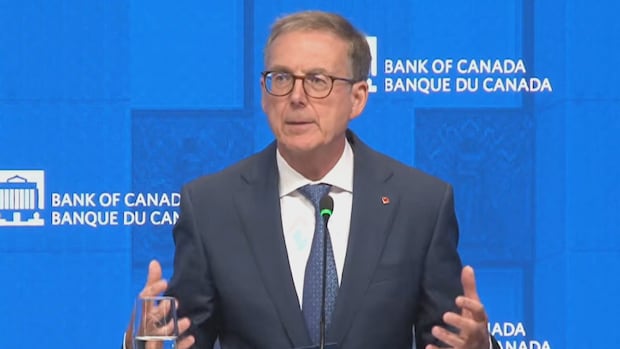
Bank of Canada governor Tiff Macklem expresses that while he hopes for a return to a ‘more normal’ Canada-U.S. relationship, he does not foresee a return to ‘the way things were’ given the current U.S. administration’s preference for tariffs and protectionist policies.
One by one, most major economic institutions in the country have revised their predictions. The consensus now suggests that the Bank of Canada will raise its key overnight lending rate on Wednesday.
While they present the economic rationale, Frances Donald and Nathan Janzen from RBC Economics remind us that the bank is viewing this year’s inflation surge through the lens of the previous one — the pandemic shock from 2022 to 2023.
“The cautionary lessons from the post-pandemic inflation surge … illustrated how supply-side shocks and ongoing cost pressures can rapidly overwhelm an economy,” Donald and Janzen noted in a recent client communication.
As a result, most economists now anticipate that the bank will raise rates, though not all agree that such an action is warranted.
Donald and Janzen argue that a quarter-point hike will not significantly influence their expectations for the economy’s trajectory. (They had previously based their forecast on the assumption that rates would increase next year.)
“Ultimately, the implication of a rate increase on Oct. 28 carries a larger significance we should not overlook: Central banks are less patient with inflation than before and are prepared to act proactively to combat it,” they wrote.
-
Bond yields are climbing to multi-decade highs. What implications does this have for Canadian consumers?
-
Sign up for Peter Armstrong’s weekly newsletter here
Ideally, we would prefer the economic reports this week to be released in reverse order. The interest rate decision is set for Wednesday, followed by GDP figures on Friday.
GDP growth was stagnant in July (0 percent growth) and is projected to have expanded by 0.1 percent in August. However, new tariffs were implemented that month, leaving the forecast’s risks skewed to the downside.
Uncertainty has become the new norm.
Both the Canadian economy and consumers have shown unexpected resilience. Nevertheless, each new hurdle chips away at Canada’s potential for growth.
On a more positive note, we will also receive an update on the Bank of Canada’s forecasts this week. The Monetary Policy Report provides the central bank’s comprehensive analysis of its outlook for the economy.