

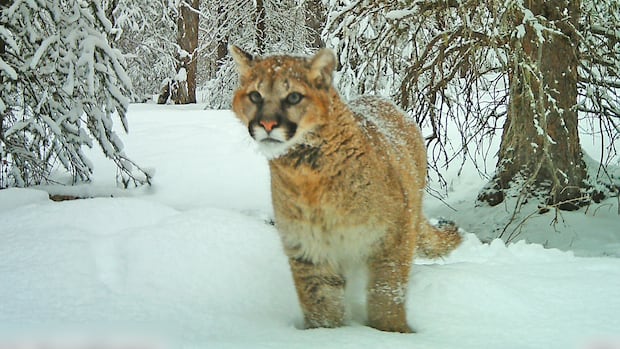

Patrick Cummins once experienced a cougar traversing his backyard, ascending onto his deck, and moving across the roof of his home.
Residing close to Bergen, Alta., Cummins did not actually see the cougar, but he observed its paw prints imprinted in the snow.
Throughout his 51 years at the property, Cummins has never spotted a cougar in person, although he has captured images of these elusive creatures using trail cameras.
“We were always aware that cougars were in the area,” Cummins remarked. “I guess we were somewhat cautious, but to my knowledge, they have never caused any trouble for anyone around here.”
However, tracks can expose an otherwise hidden predator to danger.
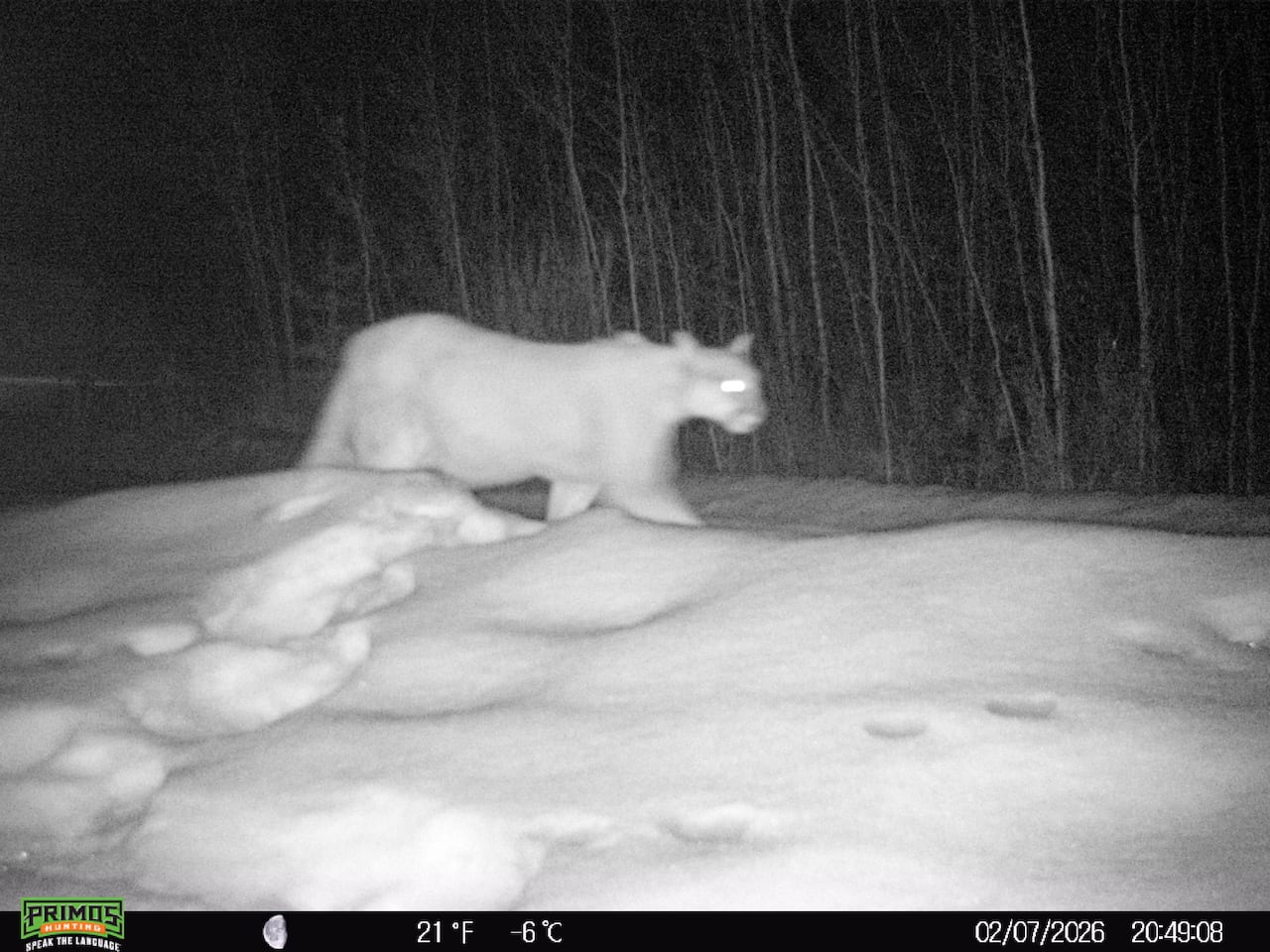
A cougar traverses Patrick Cummins’s land near Bergen, Alta., on February 7. Recent research investigates the impact of human activities on cougar survival in west-central Alberta. (Submitted by Patrick Cummins)
Recent studies from west-central Alberta indicate that roads, residences, and other human-constructed pathways intersecting cougar habitats may influence both the movement of these animals and their survival rates.
Researchers monitored 80 GPS-collared cougars over a five-year period and discovered that the risk of mortality was elevated when the animals were in proximity to homes and secondary roads, as well as when they frequently traversed human-made clearings.
Out of 37 recorded fatalities, 29 resulted from human actions.
“This primarily relates to easier access for hunters,” stated Carter Littlefair, the lead author of the study, published on Wednesday in PLOS One.
Littlefair, who conducted the research while pursuing graduate studies at the University of Alberta, mentioned that secondary roads facilitate easier access for hunters into cougar territories. Clearings also make it apparent where the animals have roamed.
“If a cougar crosses a road, it will leave tracks.”
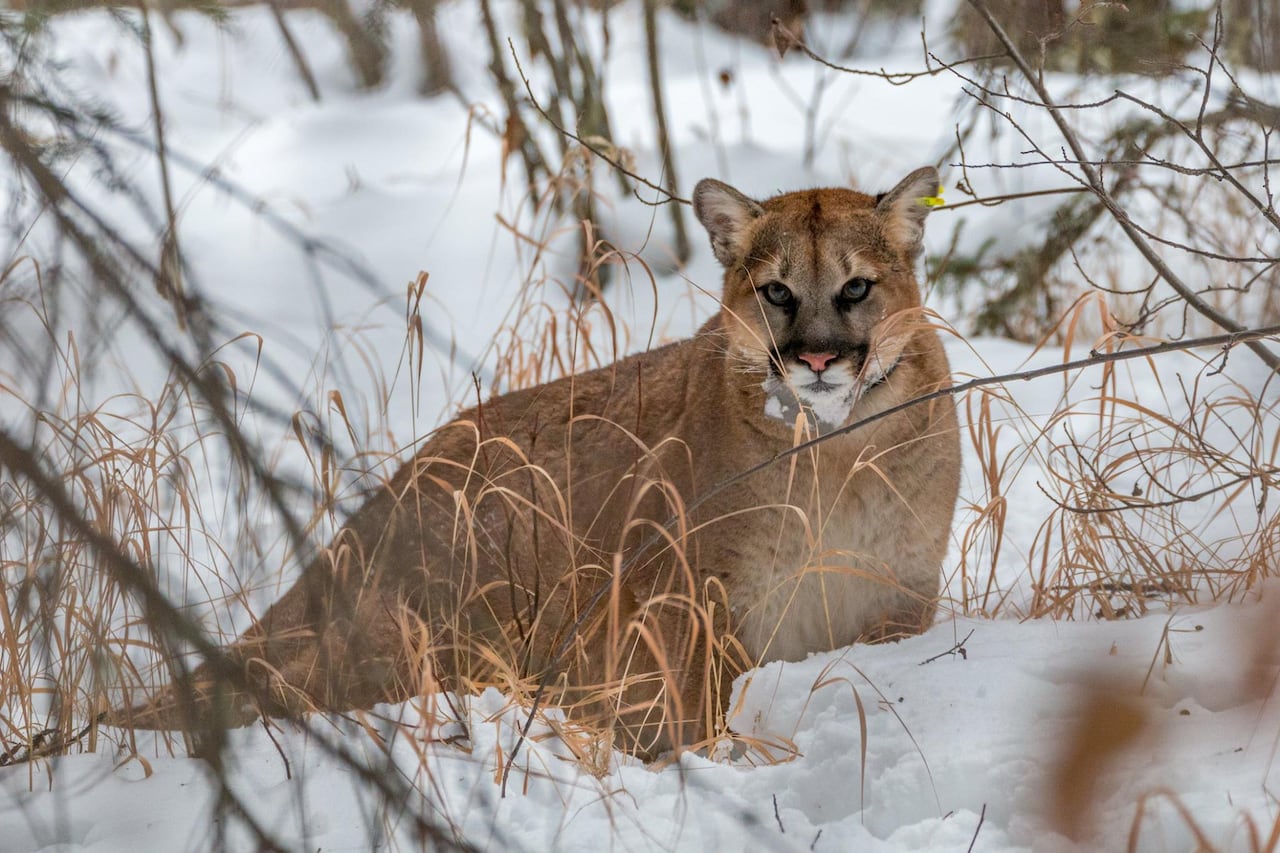
Cougars commonly avoid trails frequented by humans, which is why the province aims to decrease trail density in crucial wildlife regions. (Submitted Delaney Frame/Alberta Environment and Parks)
Connection Between Human Activity and Mortality Risk
The research tracked cougars from 2016 to 2021 through a landscape featuring secondary roads and man-made clearings like seismic lines, powerline paths, and railways.
Hunting emerged as the leading cause of death, responsible for 16 of the 37 fatalities. An additional eight cougars perished due to traps designed for other species. Five others were victims of vehicle collisions or removals involving problem animals or landowners.
The study also revealed significant seasonal variation in survival rates. The survival estimate was 96 percent from April to October, but dropped to 62 percent from November to March.
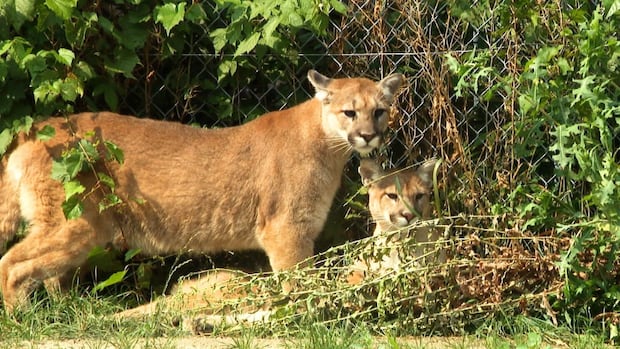
The cougar hunting season in Alberta during the study commenced on December 1 each year and continued until the end of February or until quotas were filled.
The study identified a correlation between the risk of cougar mortality and human-made structures, but it did not directly assess hunter activity. Littlefair noted that enhanced access for hunters and the potential to spot cougars may clarify the observed relationship.
Implications of the Findings for the Population
Researchers approximated the annual survival rate at around 60 percent, which Littlefair indicated is comparable to other hunted cougar populations. He added that hunting represented a smaller proportion of mortality compared to some previous studies.
Alberta Forestry and Parks informed CBC News that the mortality rates of cougars in the study area aligned with those in other populations where hunting is allowed.
The department noted that the research area encompassed approximately 15 percent of Alberta’s cougar management zones at that time and advised caution against generalizing the results to the entire province. They mentioned ongoing observations of increasing cougar populations and range expansions throughout Alberta.
The study did not calculate population size or reproduction rates, leaving researchers unable to determine if the population is expanding, stable, or declining.
-
Even low levels of backcountry recreation linked to fewer wolverines, study finds
-
Sask. survivor of crash with moose shares warning about road dangers from wildlife
Littlefair mentioned that while the research sheds light on cougar mortality, it does not ascertain whether the rate of deaths is sustainable.
For Cummins, the extent of human involvement in these fatalities was surprising.
“Yes, that is surprising,” he expressed.
“There are more individuals in rural areas now than there used to be,” Cummins noted. “So in that regard, it’s possible that an increase in human presence is contributing to the situation.”