

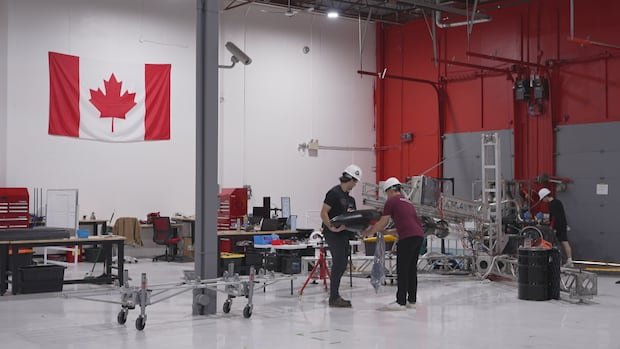

Canada, as the only G7 nation lacking its own space launch capabilities, is keen on developing a Canadian-made rocket. Several Canadian companies are in a race to provide the country with its own means to access space promptly. Meanwhile, concerns arise among some SpaceX customers about potential reduced opportunities for rides into orbit by the industry giant.
Due to the absence of domestic rocket launch capabilities, Canadian customers, including private companies and government entities, rely on external sources to deploy their satellites into orbit, with SpaceX being a prominent provider. These satellites play crucial roles in various sectors such as telecommunications, military applications like threat detection, and earth observation tasks like wildfire monitoring.
The fear of foreign entities refusing to launch Canadian technology if Canada lacks control over its own launches is a significant concern, according to Marc Boucher, the founder of SpaceQ, a Canadian space publication.
In a bid to achieve space sovereignty, the Canadian government has designated space as a key sovereign capability and introduced legislation to authorize launches from Canadian soil. Recent funding injections, including $8.3 million each for three Canadian companies, aim to support the development of light-lift rocket capabilities by 2028.
NordSpace, founded in 2022, is focused on constructing satellites, robotic space technologies, launch pads, and rockets. Despite facing setbacks in its initial suborbital rocket test launch in 2025, the company plans to make another attempt soon. Reaction Dynamics, another key player, has been working on a unique engine design since 2017, with both companies targeting rocket launches to orbit by 2028.
The newest entrant, Canada Rocket Company, is led by CEO Hugh Kolias and aims to build a medium-lift rocket powered by nine methalox-fuelled engines. The company has attracted significant private investment and is establishing a $30 million test facility in London, Ont., to support its plans.
With SpaceX planning to phase out its Falcon 9 rocket in favor of a larger vessel called Starship, concerns arise for customers reliant on Falcon 9 launches. This shift presents an opportunity for emerging rocket manufacturers like Canada Rocket Company to capture market share left by SpaceX.
The road to achieving successful rocket launches in Canada is a long-term endeavor, requiring substantial funding and meticulous testing. The industry experts emphasize the importance of sustained financial support to enable the Canadian companies to reach their ambitious goals and establish a foothold in the competitive space launch market.