

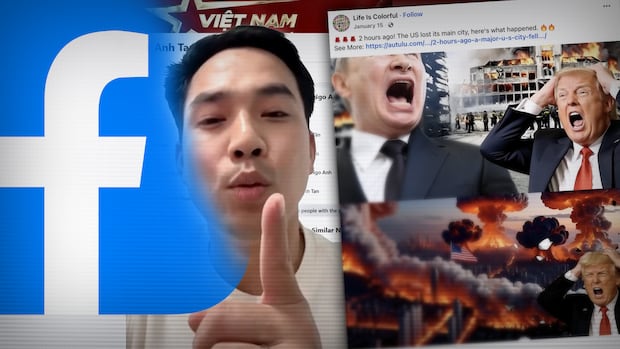

During an early 2026 corporate event featuring dancing mascots and pyrotechnics, the CEO of HTV Network, Ngo Anh Tan, proudly displayed a Vietnamese sign that read “Doanh Thu Đột Phá,” translating to “Record Revenue.” The occasion marked a significant milestone for HTV, which had grown into an “international media company” focused on authoritative journalism over the past two years, as indicated by a Vietnamese job listing boasting a workforce of at least 100 employees.
However, an investigation by CBC’s visual investigations unit and Radio-Canada’s Décrypteurs uncovered a stark contrast between HTV’s public image and its actual operations. Ngo and his team were found to be clandestinely managing an AI-driven network from Hanoi, Vietnam, disseminating fake news and sensationalized stories across global social media platforms. These stories ranged from rumors about Elon Musk banning Teslas in Canada to exploiting tragic events like the Tumbler Ridge shooting.
The investigation revealed nearly 200 Facebook pages with over 55 million followers collectively, sharing links to around 50 HTV-affiliated websites. These websites generated revenue through ad placements, often alongside misleading political and religious content. Experts, including Fenwick McKelvey from Concordia University, condemned HTV’s practices as deceitful and harmful.
HTV’s exploitation of social media for profit involved mass-producing AI-generated content, such as false reports like the “U.S. losing its main city to a Russian attack,” to drive traffic to their websites filled with ads. Despite Ngo denying any association with the HTV sites or pages, evidence from corporate records and domain registrations pointed to his involvement.
Following inquiries from CBC/Radio-Canada, HTV’s website was taken down, and Ngo’s social media profiles were privatized. Aengus Bridgman from the Media Ecosystem Observatory highlighted Facebook’s role in incentivizing such deceptive content, calling for stricter penalties to hold platforms like Meta (Facebook’s parent company) accountable for enabling misinformation.
By leveraging corporate documents, on-site investigations in Vietnam, and digital tools like DomainTools, the investigative team uncovered the intricate network of Facebook pages and websites linked to HTV Network. The research, building upon the Media Ecosystem Observatory’s report on “Facebook’s News Slop Economy,” identified key patterns and connections leading back to HTV.
The evidence pointed to a sophisticated operation run by HTV, with employees actively promoting content marketing jobs paying well above the average salary in Vietnam. Despite efforts to distance himself from the network, Ngo’s personal and corporate records firmly tied him to HTV’s activities. Following the scrutiny, HTV added a disclaimer stating their articles were meant for entertainment purposes only.
The rise of AI-driven content production, coupled with Meta’s evolving monetization policies, has fueled the proliferation of low-quality content like that disseminated by HTV. Critics like Craig Silverman emphasized Meta’s lax approach to combating such deceptive practices, urging stronger enforcement of community standards.
While Meta remained silent on the matter, the investigation shed light on the challenges posed by misleading online content in countries like Vietnam, where a vibrant but unregulated digital landscape allows unethical actors to operate with impunity.