

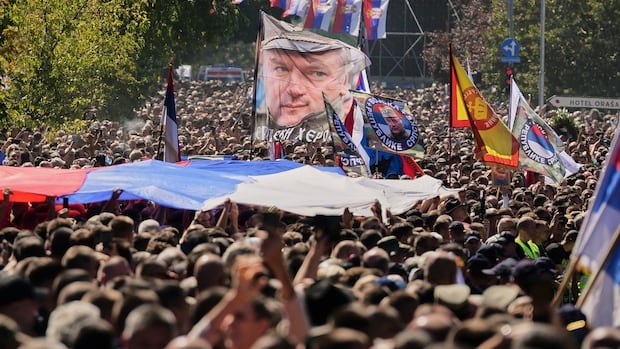

Top European Union leaders expressed astonishment on Tuesday following Serbia’s grand funeral for Ratko Mladic, a Bosnian Serb general who passed away while serving a life sentence for war crimes. The EU officials raised concerns about Serbia’s suitability for EU membership. Mladic was laid to rest in Belgrade with military honors. The Serbian Orthodox Church’s Patriarch Porfirije officiated the funeral, and Serbian army soldiers carried Mladic’s coffin at the cemetery. Several Serbian government ministers attended the service honoring the man known as the “Butcher of Bosnia,” who was convicted of perpetrating Europe’s first genocide post-World War II. Despite his crimes, Mladic is still revered as a hero by many Serbs.
European Commission President Ursula von der Leyen and European Council President Antonio Costa expressed dismay over the official support and the attendance of senior Serbian officials at Mladic’s funeral, describing it as a failure to address a dark chapter in Europe’s history and conflicting with Serbia’s aspirations towards the EU. When asked about the potential repercussions for Serbia’s EU membership bid, von der Leyen’s spokesperson stated that the matter was under review.
Although President Aleksandar Vucic did not attend the funeral, his son, Danilo, was present. Notable figures like Bosnian Serb nationalist leader Milorad Dodik and the Russian ambassador in Serbia, Alexander Botsan-Kharchenko, were also in attendance. Serbia’s Justice Minister Nenad Vujic stood with Mladic’s family at the funeral, emphasizing that the authorities ensured order during the event while the family oversaw proceedings.
Mladic was convicted by the UN International Criminal Tribunal for the former Yugoslavia for his involvement in the Srebrenica massacre in 1995, where approximately 8,000 Bosniak Muslim men and boys were killed. He was also found guilty for the siege of Sarajevo, which resulted in around 10,000 casualties.
In response to Serbian state and military officials’ involvement in Mladic’s funeral, Britain summoned Serbia’s charge d’affaires to condemn the glorification of a war criminal, stating that such actions undermine reconciliation and regional stability in the Western Balkans.
As EU Enlargement Commissioner Marta Kos previously warned, the funeral was considered a test for Belgrade, leading to the cancellation of her planned visit to Serbia due to the conflicting values. The EU’s annual enlargement report, typically released in late October or early November, evaluates candidate countries’ progress towards EU membership, with Serbia under scrutiny for its recent actions.
Vucic, a former nationalist, characterized the funeral as an emotional event, attempting to balance his support base, which includes Mladic sympathizers, while aiming to maintain positive relations with the EU. The EU’s stance on Serbia’s membership prospects has been impacted by concerns over democratic setbacks, with potential financial repercussions looming over irregularities in municipal elections.
Despite Vucic’s party having ties with the EU’s largest political grouping, the European People’s Party (EPP), some members have criticized the EPP for sheltering parties associated with convicted war criminals. Von der Leyen, a prominent EPP member, has refrained from openly criticizing Vucic. The EPP previously faced similar issues with Hungarian Prime Minister Viktor Orbán’s Fidesz party, leading to Fidesz’s suspension from the group in 2019.