

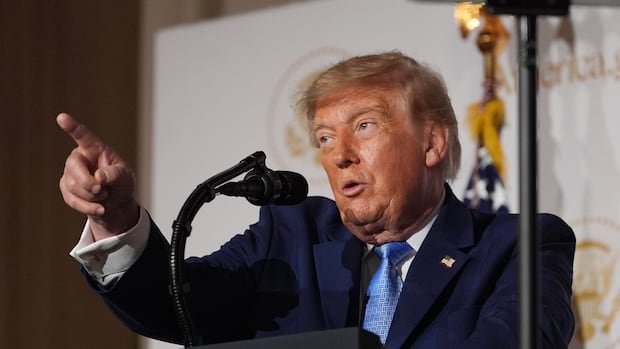

U.S. President Donald Trump announced on Tuesday that he, along with a group of artificial intelligence company leaders, has signed a voluntary agreement during a meeting at the White House. This accord will involve both internal and external reviews of the technology.
During a press briefing outside the West Wing, Trump mentioned, “I see significant self-regulation taking place. They realize the importance of self-regulating.” The announcement came after a comprehensive meeting between Trump and several high-ranking executives from leading tech companies. These companies are investing substantial amounts in developing AI infrastructure, including data centers in various communities nationwide, which have sparked bipartisan opposition.
Many executives present at the meeting have advocated for a slowdown in AI technology advancement following notable instances where AI systems have malfunctioned. Despite these concerns, Trump assured on Tuesday that the U.S. government would not impede the progress of artificial intelligence or entertain calls for restrictions or regulations.
During the unveiling of an AI chatbot named America.gov meant to assist Americans in accessing government services, Trump emphasized, “I will not hinder the growth of a technology that will surpass the Industrial Revolution. We must not impede its progress, and we are leading in this field by a significant margin.”
Notable AI executives in attendance included Dario Amodei from Anthropic, Greg Brockman from OpenAI, Jeff Bezos of Amazon, and Elon Musk, whose X social media platform incorporates its AI model, Grok. The seating arrangement at the White House luncheon had Nvidia CEO Jensen Huang seated on Trump’s right and Musk on his left. Other prominent personalities like Google CEO Sundar Pichai, Meta CEO Mark Zuckerberg, and Microsoft CEO Satya Nadella were also present.
While some AI executives have raised concerns about the rapid advancement of AI technology, others like Huang and Zuckerberg have played down the worries of AI systems becoming uncontrollable and stressed the responsibility of companies in ensuring product safety.
Vice President JD Vance, Treasury Secretary Scott Bessent, and Republican Speaker of the House, Louisiana Rep. Mike Johnson, were also part of the gathering. The unveiling of the AI chatbot took place during a day-long event in Washington, where Trump administration officials marked a “Golden Age” driven by what Trump referred to as “super intelligence.”
Following the lunch with tech CEOs, Trump expressed satisfaction with the agreement on self-regulation by AI developers and highlighted the existing regulations enforced by bodies like the Department of Justice and the FBI. To address opposition to data centers in local communities, Trump mentioned that providing financial support to local schools or reducing energy costs could be potential solutions. He warned that if opposition persisted, companies might relocate overseas.
In a television interview, Altman emphasized his company’s increased focus on safety, mentioning that they occasionally refrain from training a model to ensure safety. Hinton, a Canadian-British AI pioneer, criticized Trump’s understanding of AI, likening it to owning a tiger cub as a pet that could pose dangers if not handled properly.
Trump characterized the race to develop AI as a global competition between the U.S. and China, with the U.S. leading. He emphasized that there would be a clear winner and no second place, and expressed reluctance to cooperate extensively with China, citing the U.S.’s leading position in AI development.
This development comes after the U.S. and China agreed to establish communication channels for handling AI-related incidents during Chinese President Xi Jinping’s recent visit to Washington. However, Trump asserted his preference for limited cooperation with China, emphasizing America’s current leadership in the AI sector.