

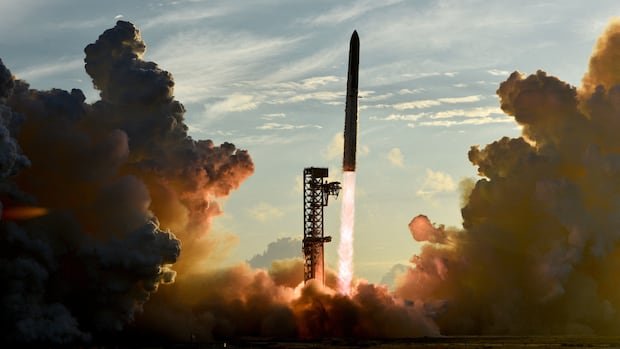

SpaceX successfully launched its massive Starship into orbit for the first time on Monday, delivering the most advanced Starlink satellites to date. However, the flight was cut short, with the spacecraft splashing down in the Pacific Ocean after just over three hours. Originally planned for a 10-hour flight encompassing six laps around Earth to demonstrate readiness for NASA’s Artemis moon program, the mission encountered a setback when one of the engines shut down prematurely after liftoff. Despite this issue, flight controllers proceeded with the mission as the remaining engines operated without problems.
The launch marked a milestone for SpaceX founder Elon Musk’s Starship rocket, the largest and most powerful ever constructed. Carrying 26 new Starlink satellites to join the existing fleet of 11,000, the deployment of these advanced satellites drew cheers from onlookers at the Starbase launch site in Texas. Following the successful satellite deployment, the decision was made to end the flight earlier than planned, with no specific reason provided for this decision. This marked the 14th full-scale launch of Starship from Texas, with previous test flights limited to the Indian Ocean region.
While the Starship achieved the intended orbit at an altitude of 275 kilometers and was planned to complete six orbits over nearly 10 hours before splashing down near Chile, flight controllers opted to return the spacecraft sooner for safety reasons after just a couple of laps. The first-stage booster was not expected to return to the launch site but instead landed in the Gulf of Mexico shortly after liftoff.
SpaceX’s cautious approach is driven by the goal of ensuring the safety of the mission and the public. Elon Musk emphasized the importance of avoiding any incidents that could harm people or property on the ground. The company aims to refine its procedures for catching and reusing the Starship in future missions, with the ultimate goal of reducing launch costs significantly.
Looking ahead, SpaceX is working towards certifying the Starship for orbital flights, a crucial step for its ambitions of supporting missions to the moon and Mars. With NASA’s Artemis III mission scheduled for next summer, SpaceX aims to play a pivotal role in facilitating space travel and exploration. The company’s focus on reusability and efficiency is expected to revolutionize space transportation, with plans to phase out older rocket models in favor of the Starship. Future missions involving the moon and potentially Mars will see collaboration between SpaceX’s Starship and other commercial space vehicles.
The development of Starship reflects Musk’s long-term vision for space exploration, originally conceived for Mars missions but now prioritizing lunar endeavors. With additional launch sites planned in Florida and Louisiana, SpaceX is poised to expand its capabilities and contribute to the next chapter of space exploration.