

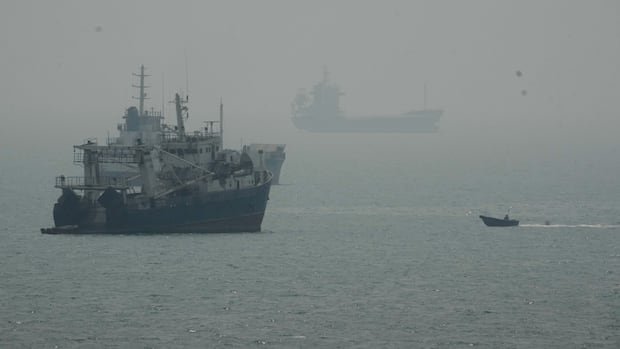

Iran announced on Wednesday that it carried out attacks on 10 ships near the Strait of Hormuz in retaliation for the sinking of five Iranian oil tankers by the U.S. This marked the most significant exchange of attacks on shipping between the two sides since the beginning of the ongoing six-month conflict.
The Islamic Revolutionary Guard Corps (IRGC) of Iran stated that it responded by launching ballistic missiles at a U.S. base near Al Azraq in eastern Jordan. Additionally, Iran fired upon two U.S. vessels and eight oil tankers that were trying to navigate through an area of the Strait of Hormuz designated as off-limits by Iran.
These attacks in and around the crucial waterway led to a surge in oil prices, with the international Brent crude benchmark surpassing $100 US per barrel for the first time since July. The conflict has caused fluctuations in oil prices, which had previously dropped to as low as $70 amid hopes for a resolution between the U.S. and Iran to facilitate the safe movement of oil tankers out of the Persian Gulf.
Tensions have been further fueled by escalating clashes between Saudi Arabia and the Houthis in Yemen, who are aligned with Iran. The recent Houthi attacks on four cities in Saudi Arabia resulted in significant fires at oil installations, causing visible damage from space. This situation has added to the uncertainties in energy markets.
The impact of the conflict is also being felt by American consumers, as gasoline prices in the U.S. have risen substantially. The average price of a gallon of regular gasoline was reported at $4.15 on Tuesday, marking a 26% increase from the previous year. Diesel prices also surged to $5.90 per gallon, representing a 59% year-over-year increase.
The Bank of America analysts expressed skepticism about the possibility of a lasting resolution before the upcoming U.S. midterm elections, and the situation may remain unresolved even beyond that point. In Canada, gas prices have similarly risen by 25 to 40% in most areas since the conflict began, prompting the government to extend the gas tax holiday until the end of January.
In response to the U.S. military’s strikes on Iranian oil tankers, Iran disclosed the establishment of a maritime restricted area extending from Chabahar in Iran to parts of the Gulf of Oman and the Arabian Sea. The exact coordinates of this restricted zone are yet to be announced. Meanwhile, a drone attack on a tanker carrying Iraqi fuel oil in Iraqi waters caused a fire on board but did not result in any casualties among the crew members.
Iran has disrupted traffic through the Strait of Hormuz, a crucial route for global oil transportation, and has threatened oil tankers in Kuwaiti and Bahraini ports. The U.S. has implemented a military blockade on Iranian ports in response and claims to have facilitated the passage of many tankers through the strait. However, the accurate assessment of the extent to which oil is being transported through the region has become increasingly challenging.
Recent data indicated that only six ships with transponders crossed the region in the past 24 hours. Iran also reported launching ballistic missiles at a U.S. base in Jordan, claiming to have caused significant damage. Jordan, on the other hand, stated that its air defenses intercepted 18 out of 20 Iranian missiles, with the remaining two landing in unpopulated areas without causing any casualties. The ongoing conflict has seen Iran targeting U.S. bases in the region, including a strike in July that resulted in the death of two U.S. military personnel in Jordan.