

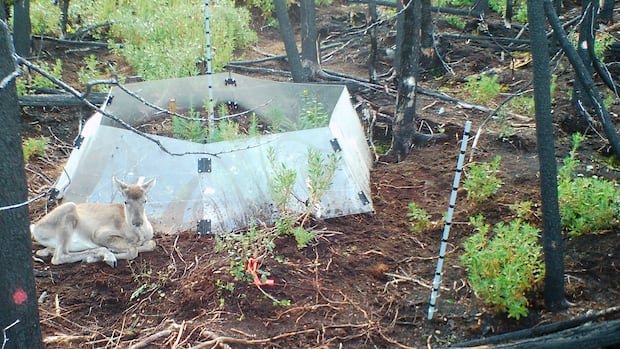

A researcher studying the regrowth of forests in Atlantic Canada after wildfires is facing unexpected challenges from local wildlife. Lucas Brehaut, a wildfire research scientist, set up 19 open-top chambers (OTCs) to monitor forest regrowth post a 2022 fire near Grand Falls-Windsor, N.L. These OTCs act as mini greenhouses, elevating temperatures to simulate a warming planet. However, Brehaut encountered numerous disruptions caused by curious animals like caribou, moose, bears, rabbits, coyotes, and owls.
Out of the 19 sites, 11 suffered damage, with some animals even stealing temperature sensors. Brehaut humorously refers to one problematic site as “The Problem Child,” continually facing challenges due to animal interference. While some creatures merely graze inside the chambers, others cause significant destruction, forcing Brehaut to spend more time repairing equipment than conducting research.
Despite these setbacks, Brehaut remains understanding, acknowledging that wildlife disturbances are inevitable in their natural habitat. Kaitlyn Gaynor, an assistant professor at the University of British Columbia, explains that animals are naturally curious about novel objects in their environment. She highlights the importance of minimizing human scent on equipment and swiftly completing research tasks to reduce animal disruptions.
Animal interference is a global issue, as seen in Gaynor’s experiences in Mozambique, where baboons, hyenas, and elephants frequently disrupt research activities. Gaynor emphasizes that animals, rather than human-related factors, are often the primary cause of equipment damage or loss. Brehaut also faced challenges from human activities, such as snowmobiles inadvertently damaging his research sites during snowy winters in Newfoundland.