

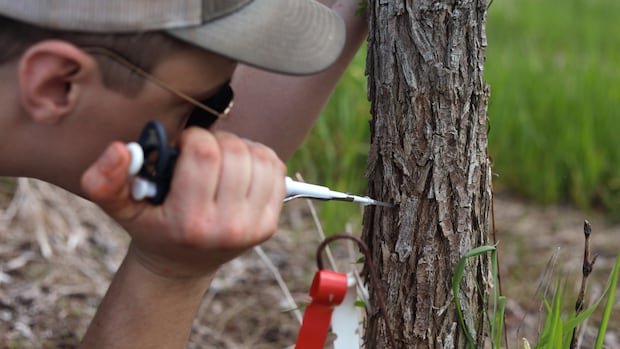

Scientists in Vermont have been intentionally infecting thousands of trees with Dutch elm disease this summer. The aim is to assess the resistance of a new generation of elms, bred from disease survivors, to the fungus spread by bark beetles. This fungus has been devastating elm populations in the U.S. and Canada for many years. The ultimate goal is to restore areas once abundant with tall elms that adorned city streets and thrived along riverbanks.
Gus Goodwin, a senior conservation planner at The Nature Conservancy, expressed the devastating impact of losing trees over the years due to Dutch elm disease. Researchers are hopeful that the Vermont experiment, along with similar initiatives in Canada, will lead to the development of disease-resistant elm tree strains.
In Fredericton, once known as the “City of Stately Elms,” Dutch elm disease took a toll in the 1960s and 70s, resulting in the loss of an estimated 10,000 trees, leaving only around 1,000 mature elms remaining. Efforts are underway to combat the disease, which attacks an elm’s water-conducting tissue, leading to rapid tree death within a few years of infection.
To combat Dutch elm disease, infected elms are promptly removed to prevent further spread. However, past practices of removing healthy nearby elms, known as “sanitization,” unintentionally reduced disease tolerance within the population. Efforts are now focused on preserving disease-resistant elm trees to enhance resilience.
Cities across Canada, from Manitoba to the Maritimes, are facing renewed threats from Dutch elm disease. Edmonton and Saskatoon have reported infected trees, prompting swift actions to contain the spread. Residents are urged to adhere to preventive measures, such as refraining from pruning elms during specific periods.
While the battle against Dutch elm disease continues, the loss of mature elms poses challenges in urban environments. These trees provide essential benefits like shade and stormwater absorption, contributing to climate change mitigation. Efforts to restore elm populations are crucial for building resilient ecosystems.
Scientific projects in North America, including the Elm Recovery Project in Guelph and Fredericton, focus on breeding disease-resistant elms. These initiatives involve crossbreeding and cloning trees that can withstand Dutch elm disease. While these efforts require time, they offer hope for coexisting with the disease and preserving elm populations for future generations.