

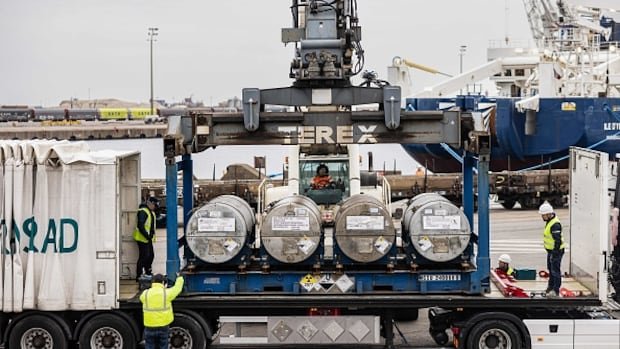

In the midst of Russian President Vladimir Putin’s military operations at Ukraine’s largest nuclear facility and assaults on the nation’s power systems, both Europe and the United States continue to rely on Russian nuclear fuel to sustain their electricity networks.
One of the beneficiaries of this arrangement is Canadian-owned Westinghouse Electric, which acquires low enriched uranium (LEU) from Russia to fuel commercial nuclear reactors in the U.S., as per shipping data scrutinized by CBC’s investigative program, the fifth estate.
The U.S. implemented a ban on Russian enriched uranium imports in August 2024 to reduce reliance on Russian supplies and ensure a robust domestic fuel source, as stated by the U.S. Department of Energy (DOE). However, the Prohibiting Russian Uranium Imports Act permits the DOE to waive the ban under certain conditions, with the waivers set to expire by January 1, 2028.
Reported by the Bellona Environmental Transparency Center in Vilnius, Lithuania, the U.S. imported 400 tonnes of low enriched uranium from Russia in 2025 alone, valued at around $1 billion US. Major recipients included subsidiaries of French-owned Framatome, U.S.-based Global Nuclear Fuel Americas, and Westinghouse.
While the U.S. has restricted Russian enriched uranium imports, the European Union has no such ban in place, and Canada has not sanctioned dealings with Russia’s state atomic energy corporation Rosatom or its export entity, Tenex.
Advocates like Dmitry Gorchakov from Bellona urge countries to reduce their dependence on Russian sources and terminate all potential collaborations due to the ongoing conflict.
The shipping data analysis conducted by the fifth estate revealed the transportation of uranium from Russia to Westinghouse’s South Carolina facility over the years of the Ukraine conflict, emphasizing the intricate supply chain process in the nuclear industry.
Westinghouse Electric, a significant player in the U.S. nuclear sector, remains intertwined with various international entities, including Canadian firm Cameco Corporation. Efforts to mitigate reliance on Russian enriched uranium have been ongoing, with both the U.S. and Europe striving to boost domestic production and diversify their supply chains.
Despite the push for self-sufficiency, challenges persist in transitioning away from Russian supplies, given the long-standing dependence on Russian enriched uranium in global energy infrastructure. This dependency underscores the intricate nature of global uranium markets and the complexities involved in reshaping the supply landscape.
In response to these dynamics, various countries and industry players are exploring alternative sources and technologies to reduce reliance on Russian nuclear fuel and enhance energy security in the face of geopolitical uncertainties.