

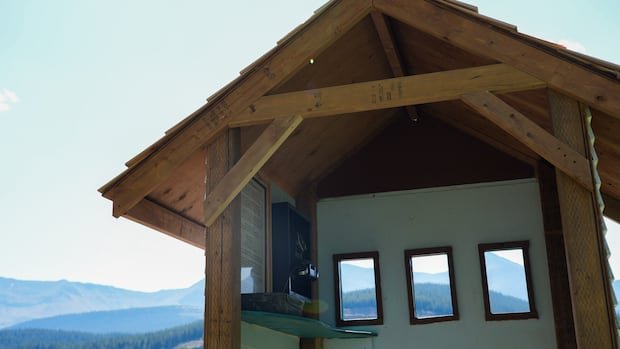

Andy McCracken, a septuagenarian, takes a moment before dialing his father’s old number on a vintage rotary telephone on a sunny late July day. He communicates through the disconnected landline in a small wooden structure next to a graveyard in Alberta’s Rocky Mountain foothills. This unique phone, known as a “wind phone,” serves as a symbolic connection between the living and the deceased, enabling visitors to have one-sided conversations with their departed loved ones.
Situated at Mountain Park Cemetery in Yellowhead County, the highest elevation cemetery in Canada, this site now hosts the highest elevation wind phone in North America, perched close to 1,900 meters above sea level. Yellowhead County installed this wind phone at Mountain Park in July.
When the time comes for Andy McCracken and his wife Anne McCracken to be laid to rest, their remains will find a final resting place at Mountain Park. The couple, currently residing in Edson, Alberta, are eligible for a plot due to Andy’s birth in a Coal Branch town located 25 kilometers northwest of Mountain Park, where his father worked as the mine doctor.
Expressing his gratitude, Andy McCracken speaks into the wind phone, thanking his father for his birth in Luscar, Alberta, in 1953 and for the joy of being surrounded by mountains. He bids farewell, sending love to his father and greetings to his mother.
Established in 1911, Mountain Park served as the terminus of the Grand Trunk Pacific Railway line until 1950, when the coal mine ceased operations permanently. The community once boasted around 1,000 residents inhabiting 100 homes. Today, only the cemetery remains, housing 269 documented burials dating back to 1913.
During an interview at the cemetery, Madison Sharman, heritage co-ordinator for Yellowhead County, pointed out a remnant where the train tracks once diverged, now concealed by greenery. Accessible only by train during the mine’s operation, Mountain Park relied on the railway as its lifeline to the outside world.
Residents of the town created their entertainment in the secluded wilderness, with men engaging in foot races up nearby Mount Baldy and young locals trekking an hour and a half down the train tracks to Cadomin for community dances on weekend nights.
The Mountain Park Cemetery reveals tales of frontier struggles despite the romanticized notion of life in the subalpine with minimal external connections. Pat Rausch, a frequent visitor since 1963, highlighted the poignant infant burial sites, hinting at the hardships faced in the early years of the coal town.
Tragic stories emerge from the cemetery, including four deaths during the Spanish flu pandemic of the late 1910s and 17 fatalities from mining accidents at the Mountain Park mine. These tragedies resulted from cave-ins, crushing accidents, and coal dust inhalation.
Efforts to restore the cemetery were led by Mary Salzsauler and a group of volunteers, including the McCrackens, who contributed their time to refurbish the gravesites. Anne McCracken finds solace in visiting their chosen plot, seeing it as a place of peace rather than sorrow.
Andy McCracken, an enthusiastic outdoorsman and former park ranger, views this resting place as a completion of his life’s journey, returning him to the mountains of his birth and his father’s explorations. Yellowhead County has integrated Mountain Park Cemetery into its management, preserving the history of those interred while accommodating new cremation burials for local residents.
Recent burials at the cemetery include Frank and Agnes Lovsin, founders of the Freson Bros. grocery chain, and John Mitchell, a D-Day veteran and Knight of the National Order of the Legion of Honour in France. Sharman emphasizes the welcoming nature of the cemetery’s residents, appreciative of visitors and the shared memories that bring the site to life.
The wind phone booth at Mountain Park features a poem by Sharman, reflecting on the enduring nature of love, memories, and stories shared into the wind, intertwining with the landscape once more.