

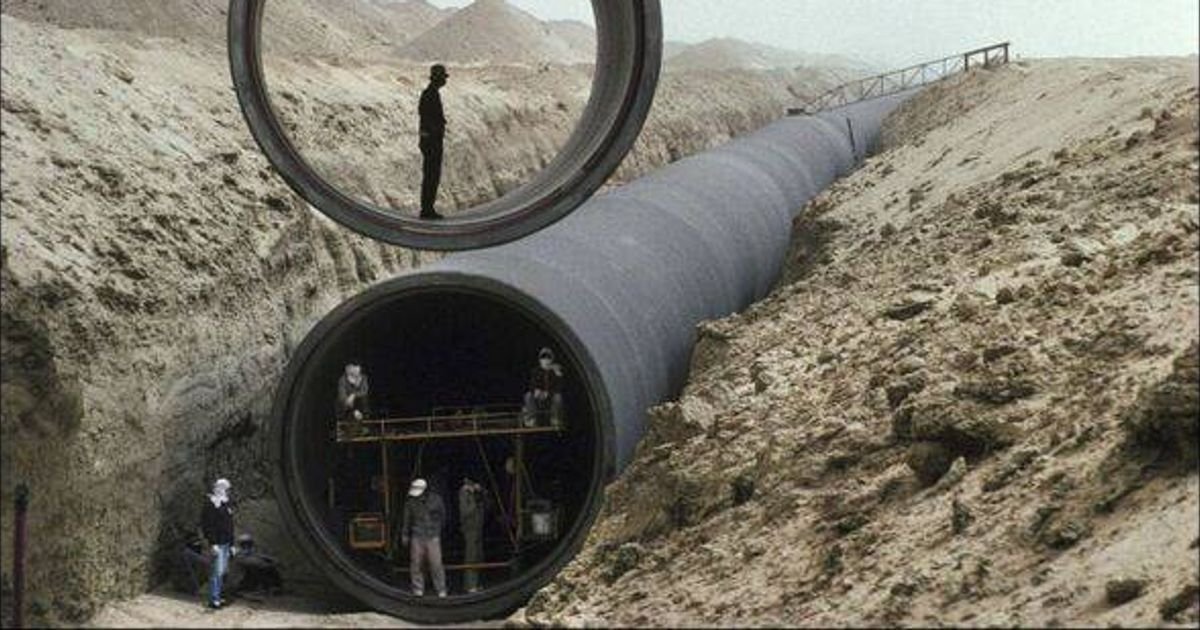

A significant man-made river, known as the Great Man-Made River (GMMR), is set for further expansion through a new £5.1 billion development phase, solidifying its status as the largest irrigation project globally. This engineering marvel in the African desert is designed to address water scarcity in a North African country by utilizing ancient underground water sources known as “fossil water” from the Nubian Sandstone Aquifer System (NSAS) that dates back to the ice age.
Covering the entire expanse of Libya, the Great Man-Made River Project aims to access freshwater reserves from the NSAS, one of the oldest and largest aquifers on Earth located beneath the Sahara Desert and spanning parts of Libya, Egypt, Chad, and Sudan. The discovery of these aquifers during oil exploration in 1953 led to the inception of the GMMR project in the late 1960s.
Funded by the late Libyan leader Muammar Gaddafi, who hailed it as the “eighth wonder of the world,” the GMMR project had an estimated budget of $25 billion (£18.5 billion) to support its massive infrastructure. The scale of the project is immense, with materials equivalent to building “20 Great Pyramids of Giza” required for its completion, including around five million tonnes of cement and steel wires long enough to encircle the earth 280 times.
Implemented in five phases, the GMMR’s operational pipelines, spanning 1,750 miles with additional segments totaling 2,485 miles, have a daily water capacity of approximately 1.7 billion gallons. The ongoing fifth phase, nearing completion by December 2025, is estimated to cost $7 billion and aims to extend water access to rural and northern areas that are currently underserved.
Despite progress, challenges such as funding reductions post the 2011 civil war, power supply issues, infrastructure damage, and supply chain difficulties have impeded the project. Nevertheless, the GMMR serves as a crucial solution to water shortages in Libya’s coastal regions, offering an alternative to overexploited coastal aquifers and costly desalination processes.
The Great Man-Made River Authority (GMMRA) underscores the project’s strategic importance in addressing drinking, irrigation, and industrial water scarcity in Libya. However, concerns persist over economic sustainability due to a gap between production costs and consumer pricing, compounded by the finite nature of the resource, raising fears of possible depletion by the end of the century.