

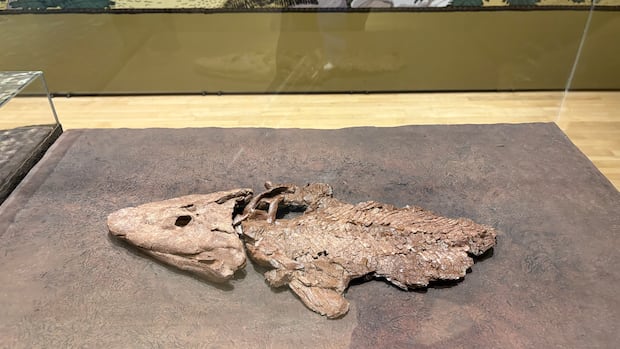

A recent investigation focusing on a 380-million-year-old fossil discovered in Nunavut has raised intriguing inquiries among scientists regarding the initial development of necks in tetrapods.
Since its unearthing on Ellesmere Island twenty years ago, the fossil Tiktaalik roseae has been identified by researchers as the earliest known tetrapod, or four-limbed creature, showcasing a natural distinction between its skull and shoulder region. Scientists have proposed that this animal developed a neck to enhance head movement as it transitioned to terrestrial life.
Dana Korneisel, a postdoctoral researcher at Carleton University, leads the new research published this month in the journal Nature. A collaborative team from Carleton and the University of Ottawa conducted experiments on lake sturgeon, which serve as the closest existing anatomical comparison to Tiktaalik roseae.
Researchers from Penn State University and the University of Washington in the U.S. also contributed to the study.
After conducting their tests, the team determined that Tiktaalik roseae likely had the capability to bend its neck by less than six degrees from side to side.
“The previous assumption was that the emergence of the anatomical neck … would be accompanied by a greater ability to bend and twist the neck and to move the head in relation to the body,” Korneisel noted.
“Our findings indicated a very restricted range of motion in bending, both laterally and vertically, comparable to what is observed in contemporary fish.”
Hillary Maddin, a paleontologist at Carleton University and co-author of the study, expressed that these results open up new inquiries and hypotheses regarding the evolution of necks.
“It may have been more about enhancing the independent and stable support of the limbs and shoulder girdle on the substrate as it began to adapt to movement on land,” Maddin explained.
The necessity for limb movement
Based on the findings from the tests on modern lake sturgeon, researchers now propose that Tiktaalik roseae evolved its neck to gain better control over its forelimbs. Korneisel mentioned that limited research has previously been conducted into the bending or twisting capabilities of early tetrapods’ necks.
She noted that the study benefited significantly from a prior three-dimensional reconstruction of Tiktaalik roseae’s neck area, created by co-author Tom Stewart at Penn State University.
In addition to Tiktaalik roseae, the researchers analyzed fossils of other ancient tetrapods to ascertain neck dimensions, which were applied to the spine of a modern sturgeon using a universal testing machine at the University of Ottawa.
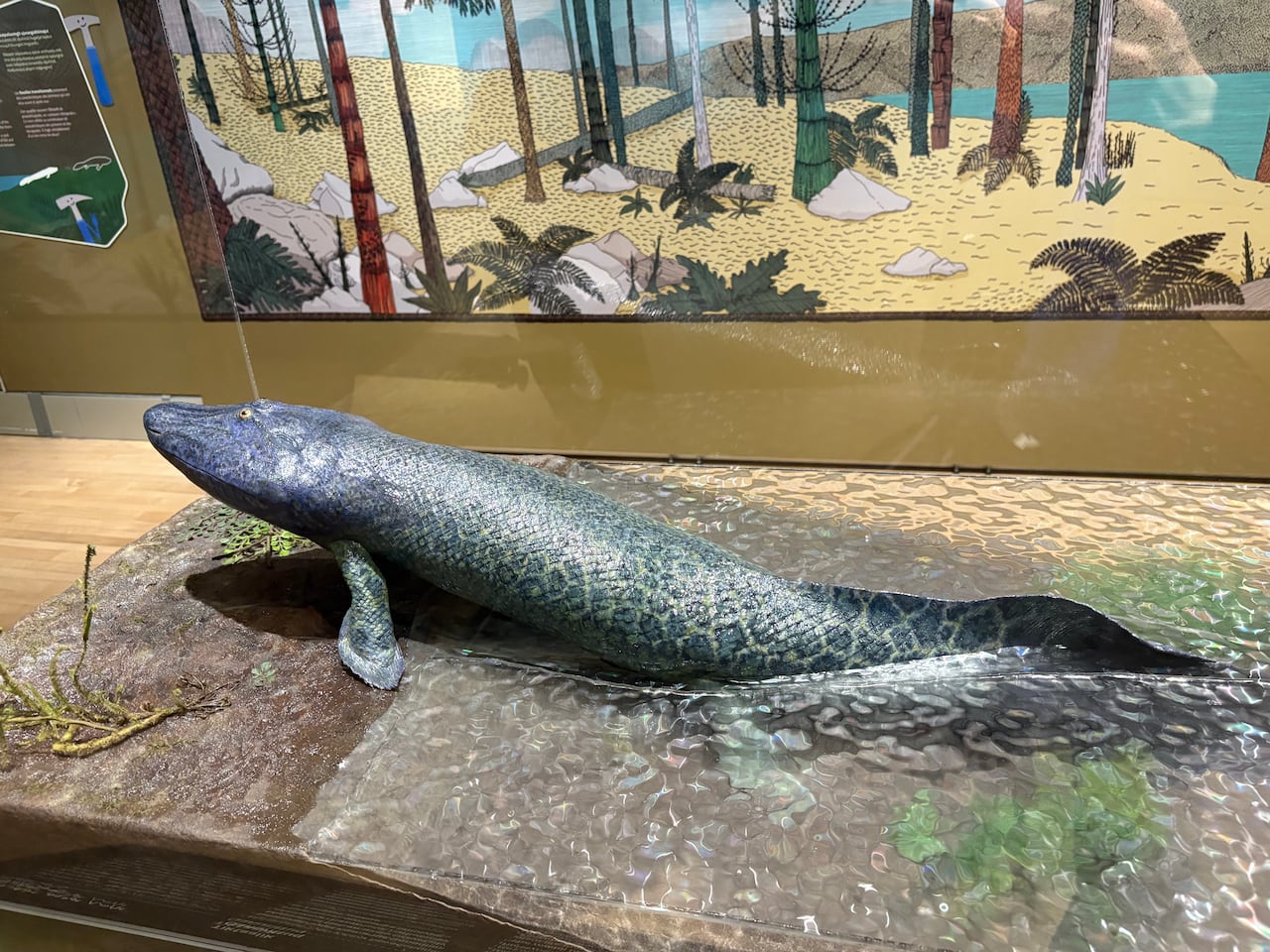
A contemporary recreation of Tiktaalik roseae at the Canadian Museum of Nature in Ottawa. This prehistoric tetrapod is thought to be the first species to have developed a neck. (Liam Baker/CBC)
“There’s an evolutionary force at play that is leading to the separation of the shoulder girdle from the skull … if the advantage isn’t about allowing more head movement, what could be the evolutionary rationale for this?” Korneisel questioned.
“What aligns with other available data from various researchers is that the pectoral girdle and forelimb were being utilized for new types of motions and forms of locomotion.”
In this new research, the authors conclude that the limited neck mobility in early tetrapods was likely more beneficial for optimizing swimming patterns and aiding shoulder support during the movement of the forelimbs.
Connections to human evolution
While this study offers a potential alternative perspective on the reasons behind the initial development of necks in tetrapods, Korneisel expresses a desire to conduct further tests on other well-preserved early fish specimens. She believes such testing could yield deeper insights into the overall movement of Tiktaalik roseae and other primitive tetrapods.
Maddin adds that the findings also shed light on human evolution.
-
Nunavut’s ancient Qikiqtania fish fossil helps shed new light on evolution
-
Video
Arctic fossil unveiled at nature museum
“Considering the stage of life on Earth at that period, vertebrates, the animal group we are part of, were quite scarce. Thus, this represents a crucial milestone in the evolution of our lineage and all land-dwelling vertebrates,” Maddin stated.
Tag: rewrite-pending