

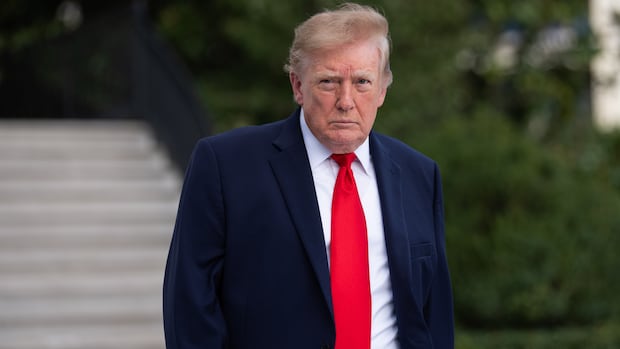

President Donald Trump is preparing to remove tariffs on various Canadian goods while imposing new duties on others, as Republican representatives from border states advocate for relief from trade measures that have placed them in a precarious political situation before the midterm elections in November.
On Friday, Maine Republican Senator Susan Collins announced that the Trump administration will eliminate tariffs on certain paper and plastic items, refrigeration and packaging machinery, agricultural equipment, as well as seaweed and algae products, among other items, following her explanation of the negative impact these tariffs have had on consumers and businesses in her state.
In August, Trump imposed a 50 percent tariff on these products, seemingly in retaliation for Canada’s counteractions against certain U.S. goods that followed the commencement of the trade war initiated by the president last year.
While the White House has decided to lift tariffs on some products crucial to a politically sensitive swing state, it also announced the introduction of new Section 338 tariffs on items such as specific valves, carpets, and waste materials “to continue addressing Canada’s discriminatory treatment of U.S. commerce.”
The new six-page list of Canadian products facing the 50 percent tariff includes shampoos, cocoa powder, window air-conditioning units, archery equipment, and canoes shorter than 7.5 meters, among various others.
Collins emphasized that the Canadian products receiving a tariff exemption are “essential” for several Maine businesses and farms, and finding U.S. alternatives would be challenging.
For instance, she noted that Maine’s blueberry farmers depend on specialized harvesting boxes made in Canada that are compatible with their existing processing equipment. Additionally, a U.S. supplier of cardboard totes commonly used in agriculture has recently ceased production of that product, “leaving producers with no option but to source from Canada,” she stated.
In a social media announcement regarding these changes, Collins said, “I will continue to work closely with administration officials to seek further relief and promote a broader trade agreement with Canada, our neighbor, ally, and largest trading partner.”

U.S. Sen. Susan Collins campaigns in Fryeburg, Maine, earlier this month. Collins, a Republican, is in a tight race with Democrat Troy Jackson. (Spencer Platt/Getty Images)
Collins, who has served in the U.S. Senate for 30 years, is in a tough re-election battle in Maine as she faces off against Democrat Troy Jackson, who has made Trump’s trade war with Canada a key focus of his campaign.
As a moderate Republican who has previously clashed with Trump, Collins had earlier urged the administration to eliminate U.S. tariffs on products like road salt, as her state relies on Canadian supplies to keep roads clear during winter.
Another Senate candidate from a border state, Michigan’s Mike Rogers, has openly called for an end to the trade war with Canada, stating that the tariffs have increased prices when inflation is already a concern.
Surveys indicate that Trump’s trade dispute with Canada is highly unpopular among American voters across both major political parties.
-
Lawsuit challenging Trump’s tariffs against Canada filed in U.S. court
-
Podcast
How Canada and tariffs are factoring into U.S. midterm elections
The decision to reduce tariffs coincides with Trump’s assertion that Canada “very much wants to make a deal” with the U.S. to restore trade harmony, while inaccurately claiming that Canada has been profiting “$90 billion a year” from the U.S.
This appears to reference the U.S. trade deficit in goods with Canada, which Trump’s own U.S. Trade Representative estimates at $48.3 billion — largely attributed to U.S. refineries purchasing significant amounts of Alberta oil at discounted rates compared to global prices. The U.S. consistently enjoys a trade surplus in services with Canada.
While hinting that a bilateral agreement might be forthcoming, Trump has repeatedly indicated his commitment to his tariff strategy.
At a rally in Fort Myers, Florida, one of several solidly Republican states where he is working to bolster the party’s vote, Trump stated that “tariffs” remain his “favorite word” because they have “made us rich.”

Prime Minister Mark Carney, speaking in Istanbul on Friday, said a trade deal with the U.S. could be signed ‘this afternoon’ if the Americans ‘were there.’ Carney said ‘we don’t care about the timing.’
Meanwhile, Prime Minister Mark Carney stated during a visit to Turkey that Canada is ready for a mutually beneficial trade deal with the U.S. that safeguards Canadian interests, but there is no urgency for it.
“We could finalize it this afternoon if the U.S. were available. If it takes months or even longer, or requires another administration for a proper agreement to be established, we are fine with that,” he remarked.