


According to Canada’s former representative to the European Union, it is crucial for Canada to strengthen its ties with Europe, irrespective of the ongoing U.S.-Canada trade tensions.
In a speech delivered in France on Wednesday, European Commission President Ursula von der Leyen praised Prime Minister Mark Carney and expressed Europe’s desire to facilitate Canada’s status as an “associate member” of the EU.
However, the specific implications of this status are still ambiguous, as there is currently no formal classification of “associate member” within the EU framework.
Jonathan Wilkinson, Canada’s soon-to-be ambassador to the EU, noted that both parties are still “some distance away” from agreeing on a definition for this potential relationship, let alone a formal title.
On the other hand, Conservative Leader Pierre Poilievre has voiced concerns that any form of EU membership might obligate Canadians to “pay higher taxes to a European government or adhere to laws established by European officials.”
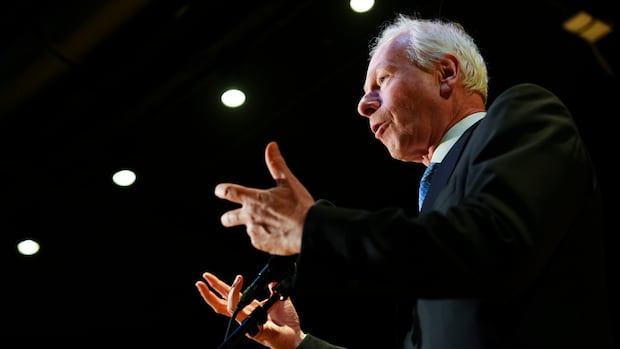
Former Liberal leader Stéphane Dion, who served as special envoy to the EU from 2017 to 2025, asserts that such scenarios are highly unlikely. Below is an excerpt from his discussion with As It Happens host Nil Köksal.
It appears that there was a warm welcome for Canada and Prime Minister Carney today. However, the term “associate member” … what does that imply to you? Are you pleased to hear that phrasing?
I believe President von der Leyen aimed to convey her ambition for the Canada-EU relationship. She is also trying to encourage EU member states to adopt a similar level of ambition.
What the prime minister seeks to avoid is any implication that Canada might relinquish some of its sovereignty to Brussels, or that federal or provincial powers would be governed from there.
I think the prime minister will clarify in his speech tomorrow [before the European Parliament] that he desires a robust relationship, one that allows for trade, military collaboration, contracts, and scientific partnerships, while maintaining the sovereignty of both nations.
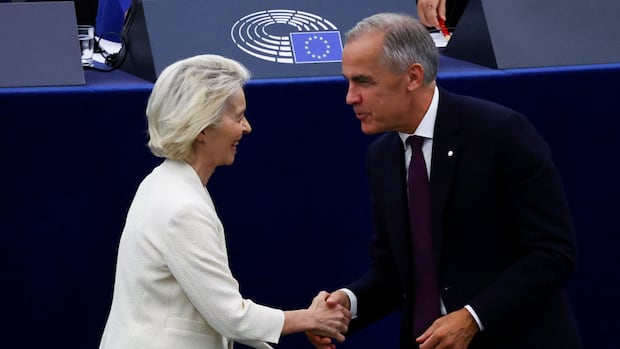
European Commission President Ursula von der Leyen has proposed opening a path for Canada to become the European Union’s first associate member, a status that doesn’t currently exist.
Do you perceive that Canadian officials might be caught off guard by this language from Ursula von der Leyen, or were they anticipating it and ready to respond diplomatically?
I suspect they are somewhat surprised, and the leaders of the EU member states might be as well.
However, the essential point for all of us is that it’s not about the label we assign. It’s about the necessity of fostering a stronger relationship between Canada and the EU for the long term.
The pivotal moment will occur on October 29th and 30th in Canada during the upcoming summit between the EU and Canada. I think the prime minister will announce the location for the summit tomorrow. At this meeting, we need to evaluate the progress of our relationship and explore future possibilities.
When you were in your previous position, could you have envisioned this level of closeness or that this topic would be under discussion now?
Yes, we consistently aimed to enhance our relationship with the EU. The specific label we would use was not a concern back then. It has become a topic of discussion today. However, the label is one aspect; actual results are another. I am now focused on tangible outcomes.
For instance, we have long discussed the need for cooperation on critical minerals. Now, we must see significant investments from Germany, France, Italy, and Poland in Canada to develop these mining ventures and supply the resources to the market, including the EU market.
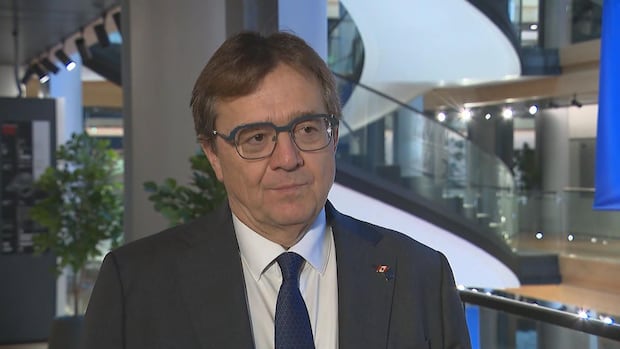
Jonathan Wilkinson, Canada’s incoming ambassador to the European Union, says ‘we’re not there’ after European Commission President Ursula von der Leyen offered to open the door to associate membership. ‘What we’re focused on is actually driving results,’ he said, adding the government will ‘eventually’ turn to how to describe the relationship.
Conservative Leader Pierre Poilievre expresses concerns regarding issues that you seem to believe are not currently on the table. Should Canadians be worried about sovereignty matters at this point?
Yes, but the notion of Canada becoming an EU member has never progressed. We have never agreed to the loss of sovereignty that such membership would entail. They would face considerable challenges in accepting us as a member due to fears of our competition, particularly in agriculture. Therefore, it would not be feasible.
What is feasible, however, is establishing stronger partnerships on various issues that the prime minister will address in his upcoming speech—scientific cooperation, trade, investments, military collaboration, and Arctic matters.
They said “no” in a referendum in Iceland … to continue discussions about potentially joining the EU were met with concerns about sovereignty and fishing rights. This is not a concern raised only by Pierre Poilievre. How does the Icelandic experience relate to Canadian sentiments or concerns?
In Iceland, they went so far as to pose the question of EU membership. In Canada, this topic is not being widely discussed, with only a few voices mentioning it, but it is not part of the mainstream dialogue. Therefore, I do not see significant partisan disagreement on this matter.
We aspire to strengthen our relationship with the EU while maintaining our identity as Canada. We want to do this long-term. Not only because Trump poses a challenge for both Canada and the EU. That is one reason we seek closer ties, but it is not the sole motivator.
The primary reason is that Canada is exceptional. We are a close ally of the EU, often regarded as the most European of non-European nations. We possess the mineral resources that the EU requires. We need investments. Our positions align on numerous global issues. We find common ground on the Middle East, Ukraine, and NATO. We are a reliable partner for all these reasons.
No, Canada is not just another country. It is the primary nation with which the EU wishes to engage, as highlighted by Madam von der Leyen today.
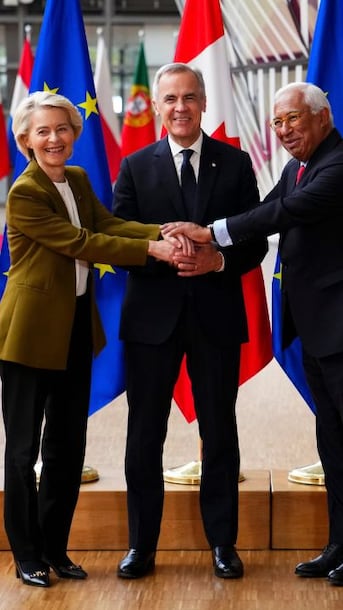
Prime Minister Mark Carney has stated that Canada is ‘not seeking to be a member of the European Union.’ However, if Canada were to pursue EU membership, is it even feasible? Here are the facts.
As you previously mentioned, the urgency of this situation may be partly due to the current dynamics with the United States. We’ve certainly heard the Carney administration discuss the exploration of new markets and partnerships. Ultimately, how much benefit could a strengthened relationship with Europe provide?
The EU faces similar challenges regarding Trump as we do, which makes Canada appear as a positive partner in North America. This serves as a motivation for deeper collaboration. However, my point is that it should not be the sole factor.
In two years, we may hopefully have a president in the White House who is more reasonable, stable, and amicable toward Canada. Even then, our goal will be to avoid placing all our reliance on a single partner.
Europe cannot replace the U.S. for us, as the U.S. will always be our primary partner. Nevertheless, Europe could help us reduce our dependency on the U.S. and encourage us to take our diversification strategy more seriously.