

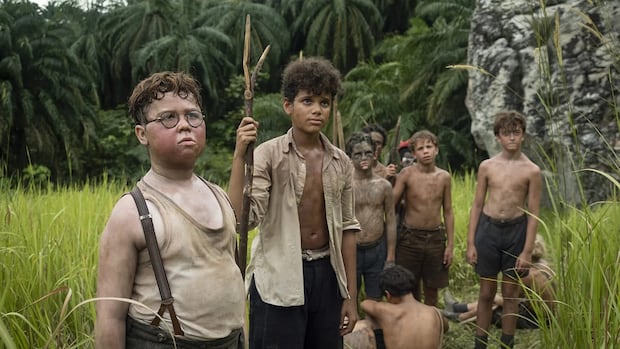

The transition from disciplined schoolboys to chaotic island inhabitants is revisited in a four-part adaptation of William Golding’s 1954 novel Lord of the Flies. This rendition offers insights into the boys’ lives prior to their shipwreck.
Crafted by Jack Thorne, known for co-creating and writing the acclaimed series Adolescence, and directed by the award-winning Marc Munden, the series is a collaboration between Eleven and One Shoe Films, with support from Sony Pictures Television for BBC iPlayer, BBC One, and Stan.
This four-episode series portrays British schoolboys who find themselves on an uninhabited island following a plane crash, devoid of adult supervision. Ralph strives to maintain order, whereas Jack tempts the boys into hunting and a clash for authority.
While there have been prior adaptations of Lord of the Flies, including a 1990 film that significantly strayed from the original narrative, this miniseries brings the characters back to their British schoolboy roots and situates the story in the early 1950s. Below are seven key points to consider about the new adaptation.
1. A return to the novel’s era
In contrast to the 1990 movie, which depicted the boys as American military cadets and shifted the timeline to the late Cold War, the 2026 series reverts to Golding’s original British schoolboys set in the early 1950s. This backdrop, emerging from the aftermath of World War II, underscores the influence of their upbringing on their actions.
Thorne argues against the simplistic interpretation of the novel as merely a depiction of humanity’s inherent savagery. “I don’t think that’s what Golding wrote,” he shared with CBC News. “I believe Golding’s narrative is about boys raised by traumatized parents grappling with a confusing world.”
According to Thorne, these boys, predominantly from military families, had been “cultivated in [the war’s] violence and hatred” before their experiences on the island unfolded.
2. Piggy’s name and narrative depth
In both the novel and the 1990 film, the character referred to as “Piggy” receives a derogatory nickname while at school. The new series discloses that this boy, portrayed by David McKenna, is named Nicholas, or Nicky.
Initially, Ralph (Winston Sawyers) breaks Piggy’s trust by revealing the nickname to the group. However, as time passes, their bond strengthens, with Piggy’s intelligence complementing Ralph’s leadership. Thorne describes Ralph’s evolution from “seeing Piggy as Piggy to recognizing Piggy as Nicky” as “a rather beautiful arc.”
In an interview with BBC, McKenna describes Piggy as “the responsible one who seeks to maintain calm and enforce rules.” The series also amplifies the significance of his final moments, highlighting the emotional impact on the other boys.
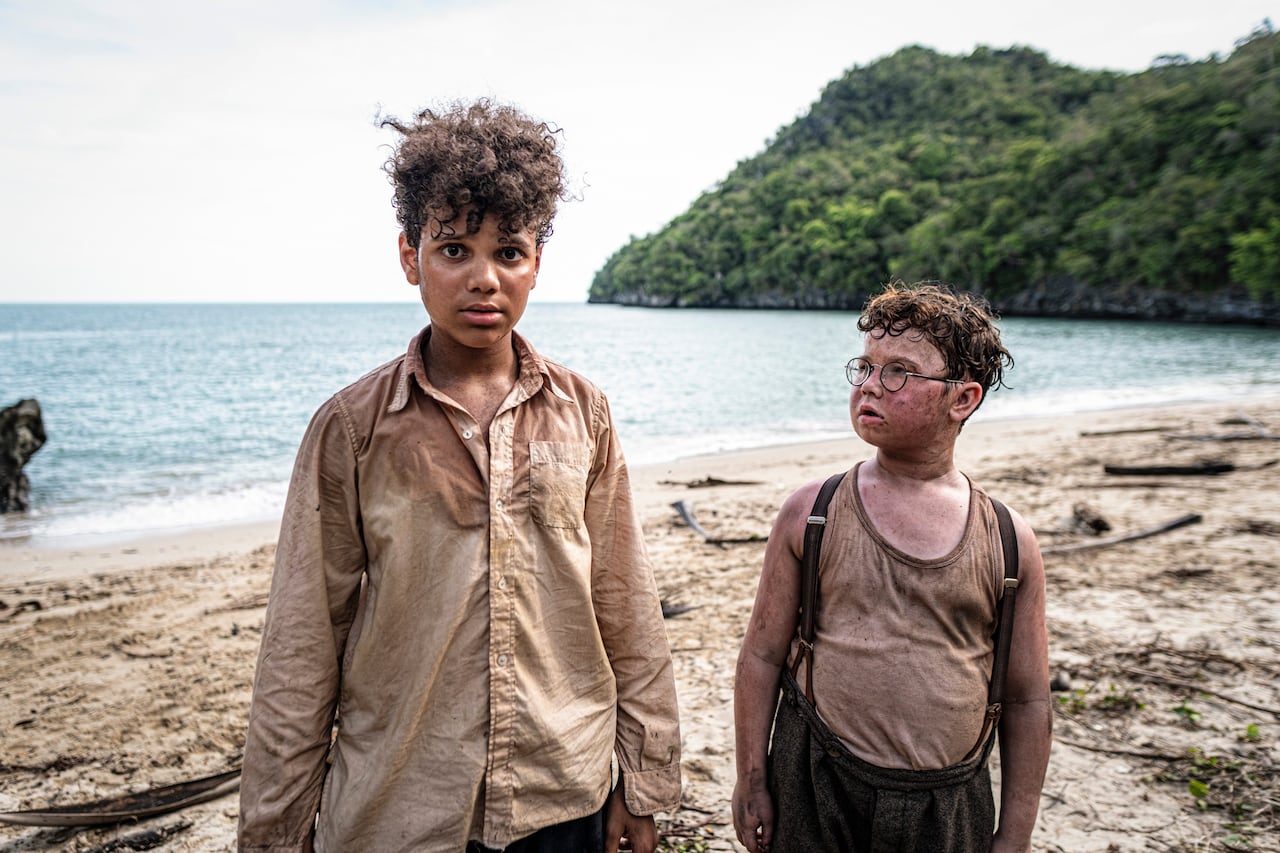
Ralph, portrayed by Winston Sawyers, left, and Piggy, played by David McKenna, in a scene from Lord of the Flies. (J Redza/CBC/Sony Pictures Television/2025 Eleven Film Ltd.)
3. Ralph’s background
In this version, Ralph is of mixed race, with a black mother and a white military father. This alteration adds a new layer to his challenge in gaining the respect of the other boys and maintaining his role as their leader.
Sawyers characterizes Ralph as someone who remains committed to his values even as the group disintegrates. “He refuses to align himself with the antagonists,” Sawyers told BBC.
“Ralph is firmly grounded in his identity and beliefs. By the conclusion, he is traumatized, battered, and essentially broken — yet he endures.”
4. Depth of characters and their backstories
While the 1990 film emphasizes the disintegration of the group to create major action sequences, the miniseries is organized into four parts, with each episode focusing on Piggy, Jack, Simon, and Ralph individually.
Flashbacks provide context about their lives prior to the crash, revealing the impact of troubled family dynamics.
The series uncovers Jack and Simon’s struggles with abusive fathers, and it presents an unfiltered, intimate portrayal of Simon’s inner conflicts through his diary. Ike Talbut, who portrays Simon, describes him as possessing heightened emotional and spiritual awareness.
“He observes before he speaks,” Talbut mentioned in a BBC interview. “Simon perceives everything intensely, and from that standpoint, he anticipates what is to come.”
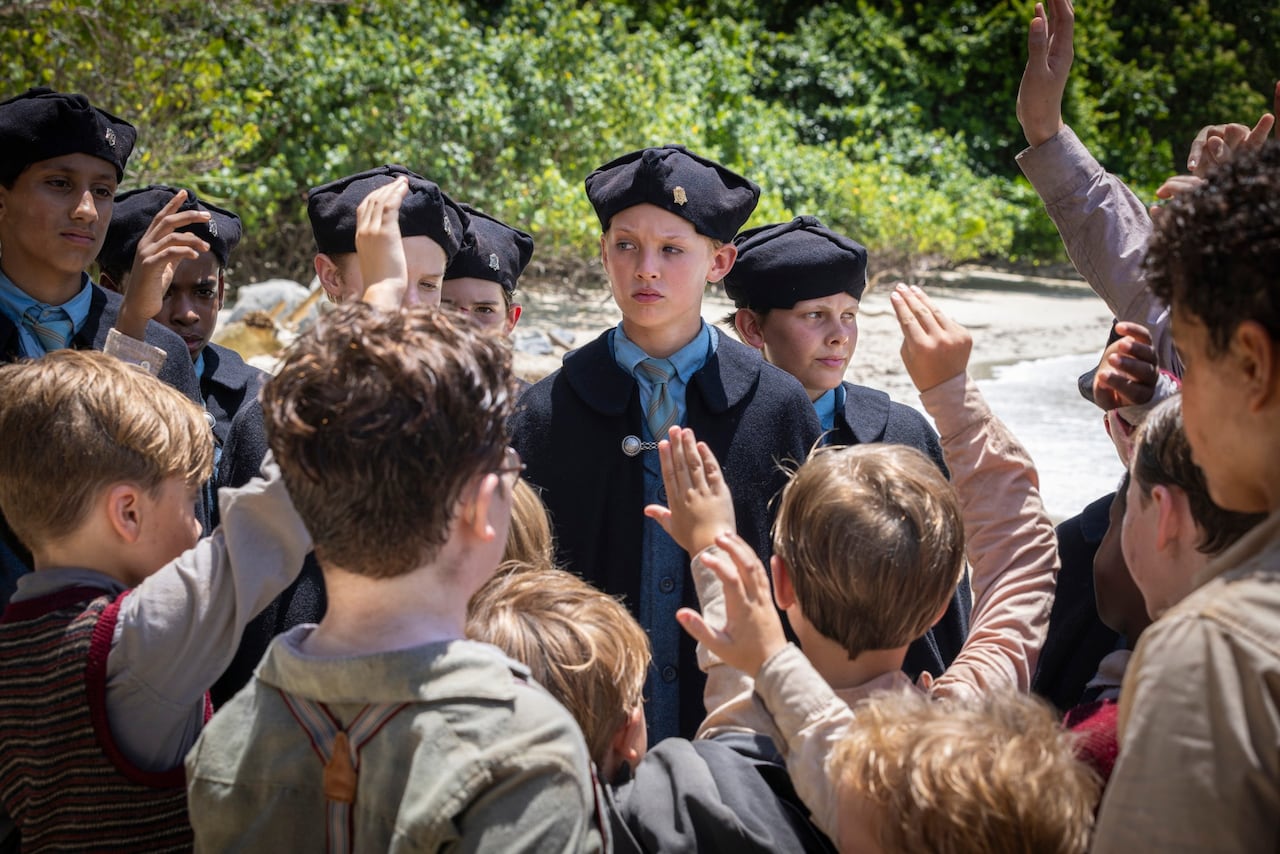
Lox Pratt, center, portrays Jack, one of the stranded schoolboys who makes a dramatic entrance leading the uniformed choir members onto the beach. (Lisa Tomasetti/CBC/Sony Pictures Television/2025 Eleven Film Ltd.)
5. The choir’s influence
The series emphasizes the visual and social hierarchy present among the boys. This includes the notable black uniforms worn by the choir members, which establish an immediate power dynamic and facilitate Jack’s initial ascent to authority.
Lox Pratt, who plays Jack, explains that the boys are attracted to Jack’s unpredictability rather than Ralph’s steadiness. “Ralph is intriguing because he is a capable leader who prioritizes the right values, while Jack offers excitement,” Pratt told BBC.
“I think people are drawn to the side that promises more excitement rather than adhering to what is right,” he added.
6. Absence of adult figures
The 1990 film features a surviving adult pilot who, although injured and delirious, does not provide much assistance to the boys. In contrast, the new series entirely omits adult characters, leaving the boys to fend for themselves and integrating the deceased pilot and fears of the “beast” into the island’s psychological environment.
For Munden, the true horror of the story arises from the boys themselves. “The Beast is us,” he expressed to BBC. “The inclination towards conflict and disorder is self-inflicted.”
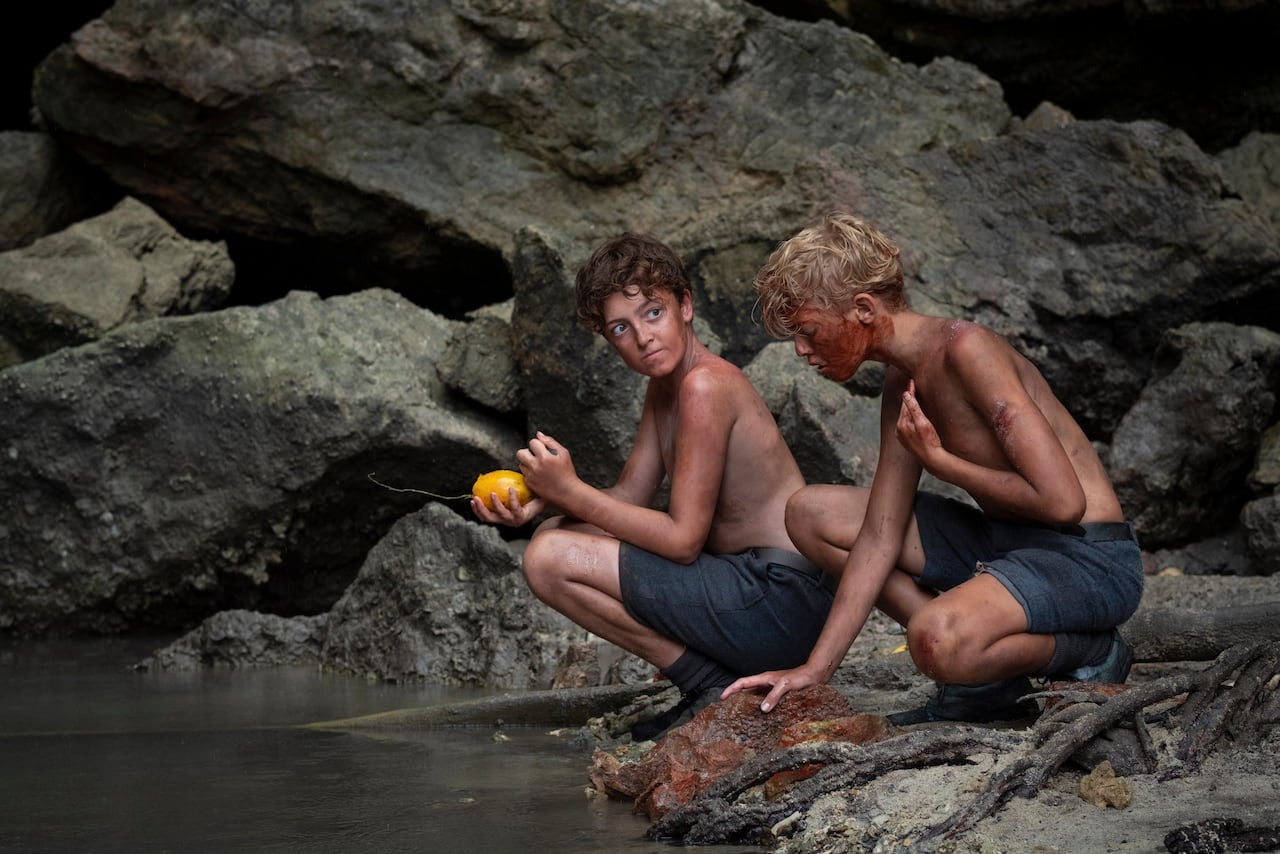
Simon, portrayed by Ike Talbut, left, and Jack, played by Pratt, crouch in a cave on the island. (J Redza/CBC/Sony Pictures Television/2025 Eleven Film Ltd.)
7. From idyllic paradise to surreal nightmare
The lush, tropical visuals of the 1990 film rendered the island appear beautiful, even as the boys’ society descended into violence. The new adaptation employs a more disquieting visual style, drawing inspiration from the dense Malaysian rainforest where the series was filmed.
Munden and cinematographer Mark Wolf implemented an infrared, “day for night” technique for scenes occurring after dusk. This method transforms green foliage into shades of pink and red, producing what Munden describes as “a hallucinatory feel, enhanced with elements of magical realism.”
The cast and crew faced the realities of filming in Malaysia’s rainforest, which Munden noted was challenging to navigate, with extremely high humidity and heat marking their days.
For Thorne, this adaptation serves as a cautionary tale about the influence of adult behavior on children.
“We must be mindful of how we treat our children. We should be wary of what we expose them to,” he conveyed to CBC News. “We exist in a time when it appears simpler to embrace hatred than love.”
The four-part Lord of the Flies will start streaming on CBC Gem on October 22, with a weekly broadcast on CBC TV at 9 p.m. (9:30 p.m. NT).