

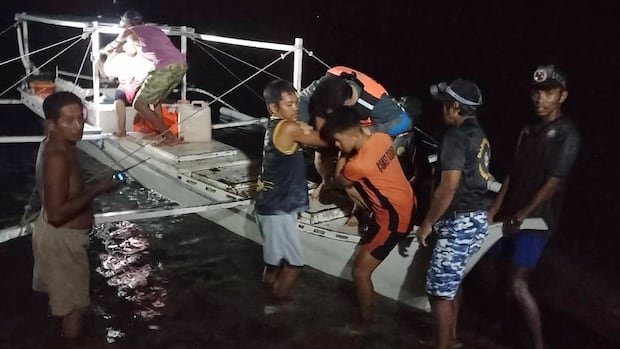

Rescuers faced challenges on Thursday in reaching a passenger ferry that had ignited and burned throughout the night off the western coast of the Philippines, resulting in five fatalities and 86 individuals missing, according to officials. As evening fell, search and rescue operations were temporarily suspended but scheduled to recommence the following morning.
Coast guard spokesperson Commodore Noemie Cayabyab disclosed that 43 individuals had been rescued thus far, with the ferry MV June Aster remaining afloat but tilted near the town of Coron following the blaze that erupted on Wednesday evening. Smoke continued to emanate from the scorched vessel by midday on Thursday.
Cayabyab mentioned that authorities were striving to verify information regarding two foreign nationals allegedly on board by cross-referencing names on the manifest and coordinating with local government entities and the shipping company to ascertain the identities of the deceased, survivors, and missing persons.
The manifest indicated that a total of 134 individuals were aboard, comprising 117 passengers and 17 crew members. The ferry, with a capacity for 306 passengers and 27 crew, had departed from Manila and was in proximity to its destination of Coron in Palawan province when the shipping company reported the fire around 6:45 p.m. on Wednesday, as per the coast guard’s statement.
Rescue teams encountered difficulties accessing the vessel due to dense smoke, striving to evaluate the situation upon gaining entry, as stated by Cayabyab.
Later that Thursday evening, search and rescue operations were suspended and slated to resume in the morning, she added.
The cause of the fire remained unknown, though one survivor suggested it may have originated in the cargo hold. The coast guard was collaborating with the shipping company and maritime authorities to gather further details.
Cayabyab relayed that the survivor recounted “a loud explosion, then followed by smoke and fire,” emphasizing the rapidity with which the fire spread.
Poor weather conditions posed challenges for rescuers, who were assisted in the search and rescue efforts by a coast guard vessel, high-speed response boats, a military ship, government boats, volunteers, and fishermen.
The coast guard broadcasted a radio alert to nearby vessels to be vigilant for ferry passengers and coordinated with coastal communities in case any passengers drifted ashore.
Despite adverse weather and rough seas, rescue operations persisted, with the ferry initially signaling distress at a distance of approximately 7.4 kilometers from Turda village but subsequently being dragged by strong currents to 14.2 kilometers off Turda.
Coron, renowned for its pristine waters, limestone cliffs, and rock formations, stands as a sought-after tourist destination.
In the Philippine archipelago, ferries serve as a common mode of transportation. Sea mishaps occur periodically due to inclement weather, inadequately maintained vessels, overcrowding, and lax safety enforcement, particularly in remote areas.
The catastrophic sinking of the ferry Dona Paz in 1987, following a collision with a fuel tanker in central Philippines waters, resulted in over 4,300 fatalities, marking the world’s deadliest peacetime maritime tragedy.