

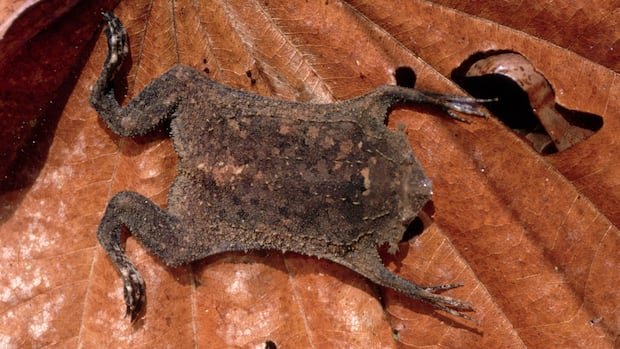

Researchers have unveiled a fascinating discovery about the remarkable abilities of the Surinam toad, shedding light on its unique hunting technique. The toad, known for its peculiar appearance and unconventional birth process, has been found to possess a remarkable sensory capability that allows it to “see” its prey using its fingertips.
Despite its limited vision and unassuming presence in the murky waters of the Amazon basin, the Surinam toad is a proficient hunter, swiftly capturing prey with astonishing precision. Through a groundbreaking study, scientists have revealed that the toad, also referred to as the star-fingered toad, relies on its fingertips to detect subtle water movements generated by nearby prey.
The toad’s fingertips are equipped with specialized touch organs that resemble the high-resolution sensors found in the human eye’s fovea. These sensitive lobes enable the toad to identify the size and proximity of potential prey, allowing it to swiftly engulf unsuspecting fish or worms without direct contact.
By leveraging advanced microscopy techniques, researchers discovered that each frog possesses 128 intricate lobes across its fingertips, significantly enhancing touch sensitivity. Despite constituting a small percentage of the frog’s skin surface, the fingertips house a majority of touch-sensitive nerves, indicating their crucial role in the toad’s hunting prowess.
This groundbreaking finding challenges conventional beliefs about brain function in vertebrates, suggesting that the Surinam toad has evolved a unique strategy to process sensory information efficiently. The study highlights the remarkable adaptability of amphibians and offers valuable insights into the evolution of sensory systems across different species.